
Breaud on Fixed Velocity, Podium on Customer Conv., Downing on Digital Strategy
Summary
This episode of Daily Dealer Live covers three pressure points in automotive: fixed-ops execution, AI that actually converts, and the realities of selling EVs on the ground. Kate Downing, COO of Williams Auto Group, breaks down digital lead generation and her dealership's move to a combined Tekion DMS/CRM platform. Podium's Jiovan Melendez, Sr. Director of Product, and Liam Golightley, VP of Customer Success, join to unpack OpenAI's case study on Podium's Jerry AI agent and how dealers coach Jerry in natural language. Lawrence Breaud, dealer principal at Autos of Forney, closes the show with a look at running a brand-new VinFast rooftop alongside a high-volume used-car buying operation.
Throughout, the conversation keeps returning to fragmentation: too many disconnected systems, too many channels, and too little context carried between them. Podium's pitch is that Jerry, a fully trained and coachable AI team member, solves that by owning the communications layer across text, call, and web, then writing the results back into the DMS and CRM dealers already run on.
Key takeaways
Podium says a third of dealers are now on its platform, and OpenAI featured Podium in a case study alongside brands like Disney, T-Mobile, and Instacart.
Jerry's "trainer agent" lets a GM retrain the AI in natural language in about a minute, versus legacy AI retraining that can take weeks.
Kate Downing says Williams Auto Group is moving its two rooftops to Tekion's combined DMS/CRM ARC platform on March 17, after years on Cox Automotive's Dealertrack, Dealer.com, X-Time, and VinSolutions.
About the Host & Guests

Host
Sam D'Arc
COO, Zeigler Auto Group
Sam D'Arc is chief operating officer of Zeigler Auto Group, a multi-state dealer group in the Midwest, and hosts Industry Spotlight on the Car Dealership Guy podcast network, along with Zeigler's Driving Vision podcast. He has more than 30 years in automotive, including nearly two decades with a global direct-insurance provider delivering F&I and insurance solutions to large dealer groups.

Guest
Jiovan Melendez
Sr. Director of Product, Podium
Jiovan Melendez is a Senior Director of Product at Podium, where he works on the AI agents that handle customer conversations for automotive dealerships and other local businesses. He has also served as a mentor with Code2040, a nonprofit focused on Black and Latinx representation in tech.

Guest
Liam Golightley
SVP, Automotive & Enterprise, Podium
Liam Golightley is a senior vice president at Podium, where he leads the team responsible for supporting and growing the company's automotive customer base. He has held multiple leadership roles across Podium's customer experience organization, including Vice President of Customer Success for Automotive. Originally from the UK, he is based in New York City.

Guest
Lawrence Breaud
Dealer Principal, Autos of Forney / VinFast of Forney
Lawrence Breaud is owner and dealer principal of Autos of Forney in Forney, Texas, which has become a VinFast dealership (VinFast of Forney). He has more than a decade of experience in automotive retail and has appeared on Car Dealership Guy's Daily Dealer Live.
Guest
Kate Downing
COO, Williams Auto Group
Kate Downing is chief operating officer of Williams Auto Group, whose stores include Williams Buick GMC and Williams Subaru in Charlotte, North Carolina. She previously led marketing, operations and customer experience for the group after an agency-side marketing career, and has discussed dealership digital strategy on Car Dealership Guy's Daily Dealer Live.
Timestamped Chapter Markers
00:00 – Introduction and episode overview
04:24 – Industry headlines and updates
06:22 – Technical difficulties and live interaction
08:01 – Kate Downing joins: COO of Williams Auto Group
10:48 – Digital marketing and lead generation insights
15:45 – DMS, CRM and the move to Tekion
21:52 – OEM partnerships and brand strategy
24:40 – CDG Circles, Numa and women in dealership leadership
32:28 – Podium segment begins: Jiovan Melendez and Liam Golightley
33:33 – Jerry and the OpenAI case study
38:34 – How to evaluate an AI vendor
40:46 – Jerry's biggest advancements
44:08 – Jerry, the DMS and the CRM
49:38 – Lawrence Breaud: running a VinFast rooftop
53:27 – Inside the used-car buying center
56:44 – EV buyers, test drives and technology
What's on tonight's show?
Sam D'Arc: Hey everybody, welcome back to another episode of the Daily Dealer Live. I'm your host, Sam D'Arc, and welcome to the space where automotive comes together to learn, to share, to grow, and most importantly, we come here to execute. Thanks for choosing to be here on this Friday, December 19th, coming to you live from Zeigler Studios. Today we're hitting three pressure points in automotive: fixed-ops execution, AI that actually converts, and EV reality on the ground. We'll start with Kate Downing today on tech and process that drives efficiency. Then we'll swing over to Podium on AI and talk about an OpenAI study that they did, which is unusual in all of automotive. And then we'll finish up with Lawrence on running a VinFast rooftop and generating real demand in that world. But first, let's hit today's industry headlines.
What happened in today's industry headlines?
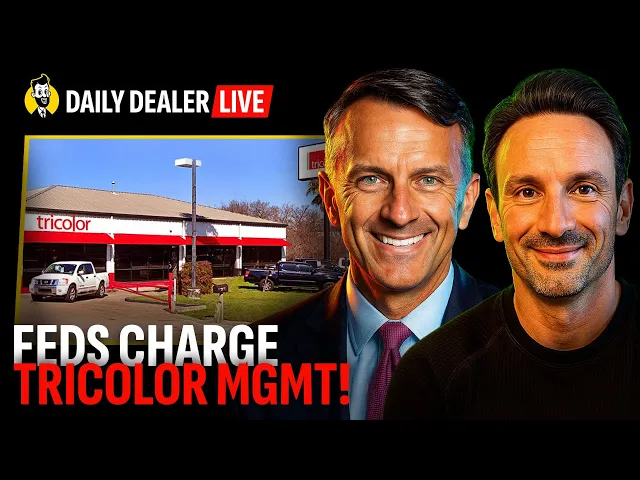
Sam: First up today, the fallout from Tricolor Holdings' bankruptcy is escalating, with federal prosecutors now charging former CEO Daniel Chu and COO David Goodame with what they describe as years of systemic fraud. According to a recently unsealed indictment, executives allegedly double-pledged the same auto loans to multiple lenders and manipulated loan data so delinquent or charged-off accounts appeared financeable, helping Tricolor raise billions from banks and investors. Two former finance executives have already pleaded guilty, and prosecutors say leadership initially tried to brush off the discrepancies as an administrative issue before Chu allegedly withdrew more than six million dollars from the company ahead of mass unpaid furloughs. As a result, JPMorgan wrote off one hundred seventy million dollars tied to Tricolor in Q3 and is now reviewing its controls, with CEO Jamie Dimon warning that the failure reflects how lax credit discipline has become over the past decade. Interesting, because we've seen a few of those failures in recent months.
Sam: Next up today, a group calling itself "Concerned Nissan Dealers" shared a new scathing letter with Car Dealership Guy News, the second we've received this year. The letter, distributed anonymously "in the interest of unity, candor, and the protection of dealer principals, employees, and their families," targets Nissan One, a simplified dealer incentive program that Nissan launched this past June. Dealers say the stairstep program is doing the opposite of what was promised, actually paying less than prior programs while raising operating pressure. The operators argue Nissan's shrinking enterprise value isn't about market demand, but years of misaligned incentives and poor management decisions that ignore dealer profitability as a core brand asset. According to the letter, Nissan One has made things worse, not better. Big picture here: dealers are demanding two things, more realistic sales objectives and real below-the-line support that restores profitability. Nissan told CDG News that it is "evaluating changes to Nissan One aimed at continued sales gains and supporting dealer financials." But the letter makes it clear that patience is running low.
Sam: Next up today, Stellantis CEO Antonio Filosa is putting the company into what investors are calling the "emergency room," a full review of its fourteen-brand portfolio as sales soften in key markets and investor pressure builds. One possible outcome being considered is brand closures or consolidation. Reuters reports Filosa is reassessing which nameplates are truly viable long term, with year-end U.S. sales likely playing a big role in those decisions. While attention is mostly on Stellantis's European brands, Chrysler keeps coming up as a question mark, with the 300 gone and the EV crossovers delayed. The brand is effectively a minivan-only operation for now. Industry observers argue Stellantis may be spreading itself too thin. Detroit Free Press analyst Mark Phelan questioned whether Chrysler should remain a standalone brand at all, and whether Stellantis really needs both Alfa Romeo and Maserati. CDG News will closely watch this as it develops.
Sam: And lastly today, Cars Commerce has just announced a CEO change. Tobias Hartmann will step into the role on January 15th, 2026, replacing Alex Vetter, who's been with Cars.com since 1998 and has led the company as CEO since 2014. Under Vetter's leadership, Cars.com moved well beyond its classified roots and built a SaaS-heavy platform through acquisitions like Dealer Inspire, AccuTrade, and Dealer Club. Hartmann comes from outside automotive. Most recently he ran Scout24 in Europe, which owns AutoScout24, and before that held senior leadership roles at HelloFresh and oversaw the eBay enterprise carve-out. His experience is centered in marketplaces, subscriptions, and platform economics. But the transition won't be abrupt. Vetter will remain on as an adviser through the end of next March, giving Hartmann time to get his footing during a period of real change in the dealer tech landscape. We'd love to have the new CEO on. It is definitely a change and a turning point in a large auto-adjacent company. Anyway, that's a wrap on today's industry news.
Why did the show start ten minutes late?
Sam: Julie, we started ten minutes late, and we did that because my laptop, as we went into today's show, completely just died. One hundred percent died. So anybody who's curious, everybody listening to this on the podcast, you couldn't care less, but for our live audience, they're like, "Why did you start ten minutes late?" That is the answer. Props to Alienware, which makes a bulletproof laptop that helped get me back up and running. But I'm moving fast now, Julie.
Julie: It's showbiz. Hey, football games are on right now at the Zeigler Auto Group. Our team, we have two teams, Western Michigan, which is our headquarters, and Michigan State, which is just north of us. They don't play today, but Western Michigan is on the football field and they're absolutely crushing it in their bowl game.
Sam: Any bowl games you're watching, Julie, this season?
Julie: Do you remember the movie Coming to America? That's the extent of my knowledge. If it's not automotive sales, I'm not an expert, unfortunately.
Sam: I like it. You're one hundred percent focused on the biz, and you're like, hey, if it's not an answer to "where's the biz," then I'm not interested. So, all right. Well, hey, as a reminder to everybody out there, we're live streaming across all CDG social media platforms. Post your comments into the show today. I just got that screen back up, so anything posted from here on out, I'll bring in. The producers are welcome to bring in whatever was posted prior to this, but we're thrilled that we are here live. Yoga Cars says, "Sam, from now on, you need backup ready to swap." And Yoga Cars, you are correct. I'm going to ask for two computers standing by so we can do that quickly, because we want to be here.
Julie: Otherwise you have to be on from your iPhone.
Sam: I had to boot up the second one. Yeah, I'd be on from my iPhone, which actually I think I could probably do. So anyway, we got a heck of a show today. Let's dive into it.
How's business at Williams Auto Group?
Sam: First up today, Kate Downing, COO of Williams Auto Group. Kate, welcome to the show.
Kate Downing: Hey, thanks for having me.
Sam: Thanks for being on the show. So we always ask everybody, Kate, first question up is, how's biz? And as part of that, Kate, tell us a little bit about yourself and what you do out there.
Kate: Yeah, well, the best time to ask that question is December 19th, right? December is the best month of the year, so business is not good today. It might not ever be. But yeah, business is good. We're tracking to hit all of our targets for new vehicle sales. A little bit light on used, but that's kind of the way December goes. The OEMs are pushing everything so hard, and rates, and it's just a new-car month, but we're having a really good month. My role here as COO, I've been here for eight years. I'm also in charge of all of our marketing and our IT. I was laughing when your computer died.
Sam: Ouch, if only. You can't have your computer die. I was one hundred percent ready to go, Kate, and then everything went black and I was like, oh my goodness, what just happened? So, drama.
Sam: So Kate, I'm fascinated by your evolution into the COO role. So let's start there. You were in the marketing world, you say still are, and you went from there into COO. You've got two rooftops, your Buick GMC and your Subaru. How do you go from marketing to COO in automotive?
Kate: Yeah, so I like to say that I am relentlessly curious and don't mind my own business sometimes. And so if I see that there is something I could possibly improve, I am just willing to jump right in and fix it, no matter what it is. And yeah, the IT thing — so I started here in marketing. I used to work for their advertising agency as their account supervisor at the agency, and then there was an identified need for somebody to be in-house. Prior to the agency, I had worked at a media company, the Charlotte Observer. So I had media company experience, then advertising agency experience, and I had always wanted to get on the brand side of things. So it was just this nice, natural entry into the brand side. I started just with marketing, heavily involved in digital marketing — that's my background, in ad ops. I came in here and overhauled the marketing, the website, Google, SEO, and just identified some places where operationally we could be a little bit more effective, and evolved into the COO role while retaining all of the advertising, marketing, and digital background.
Sam: Kept your day job as you went into the COO operations role. All right, here's my question. Before we go into what's the biggest thing you fixed as you came into this new role or what you're working on currently — you mentioned something that's on every dealer's mind in December of 2025, whether they're selling a ton of cars or they're not. Digital lead generation is top of mind for everyone. How do you connect with the car buyer online with the vehicle you have on your lot? From your vantage point, your experience, what's the number one most effective digital lead-generating tool, and what do most people miss in automotive today when it comes to digital lead generation?
What's the most effective digital lead-generation tool right now?
Kate: If I could answer that question, I think I would be a billionaire, right? There is not one, unfortunately. I think that's the truth. The automotive shopping experience is so fragmented that everyone is shopping differently, depending on geography, where your store is located, who your target customers are, whether they're digital-savvy or not. That varies. Every single customer who walks into your store has a different path. We did a fascinating study with Clarivoy that really just put to paper that that is the truth. Customers are shopping all of the third parties, shopping multiple search engines, shopping multiple brands, multiple websites, doing a lot of research before they finally make that decision to purchase. So I think what's most important is to be there across the journey, from high funnel to low funnel. To me, it's the brand's responsibility to sell the brand, sell the car, and it's our responsibility to sell them on buying it at our dealership. So once you've decided on a particular vehicle, or even a segment, I want to be there in front of your face when you're searching for that particular make, model, or even segment.
Sam: So this fragmentation across multiple channels — in your opinion, is that healthy for the marketplace, or do you see a narrowing? Because with so many different routes, that's tough for dealerships, particularly single points, two points, smaller groups, to cover all the different channels. Is it not?
Kate: Yeah, it's very difficult. So I prioritize the lower funnel, because the higher funnel is so expensive and has a lower ROI. So I think as long as you're doing the best you can to cover and saturate that lower funnel — being there in Google, having a buttoned-up Google Business Profile, making sure you have adequate paid search spend, your SEO makes sense, retargeting, excluding people who have converted — just being really efficient at that lower funnel is super important.
Sam: Yeah. So in your world, lower funnel, what are maybe two or three of the top digital lead providers? Then I'm going to ask you something about Google and pricing.
Kate: Yeah, VDPs do really well for us — again, Clarivoy kind of proved that VDPs turn into car sales. CarGurus does pretty well for us too, both new and used, which was a surprising part of the Clarivoy study for me to see. When you think third parties, you think used cars, and that's not one hundred percent of the time. People are maybe starting shopping for a used car, or maybe they're using those aggregate sites so they can filter down to the particular new vehicle they want based on features. So it's super important that your feed is up to date — your features have to be accurate, you need to make sure everything is checked off, because that's how shoppers are shopping. They're filtering for everything they want, and your car needs to be there. If your car has a sunroof but sunroof isn't checked off as a feature, it's not going to show up. So data hygiene, making sure your feed is accurate, super important.
Sam: Data hygiene — that's going and deduping your database, making sure it's all up to, maybe, a CDP, as we've talked a lot about on the show. Have you engaged in a CDP to clean up your data, your data lakes, and whatnot, to better market to your client base?
Kate: No, we have not gone down the CDP path. I am staying on the sidelines until that can get a little bit more fleshed out. I think it's a fun acronym. I don't know that it's quite there yet.
Sam: It's a buzzword for you then, huh?
Kate: It's a buzzword for me, yeah.
Sam: What's the bar it needs to get past in order for it to be something you'd pull the trigger on?
Kate: Advertiser-agnostic. I think that's part of the problem with some of the CDPs — you have to use their advertising in order to leverage the data, and I just don't think that's fair. It's my data. What you're selling should be a software solution that allows me to layer it on top of my data, for me to use as I see fit. So I don't like the approach where they lock you into their advertising, and then once you disengage with them, you lose everything you've cleansed with them. What I think is more feasible and attractive is a DMS-CRM combined solution that's able to show you your customer's full path within your native systems, rather than a CDP layering on top of it. It's one of the reasons why we engaged with Tekion, and we're really excited to move forward with both their DMS and their CRM, their complete ARC platform. From what I understand, what I've seen, that will kind of be almost what I'm calling a CDP-light, in which we can see our customers and their full journey across sales and service and everywhere they've engaged with us.
Why is Williams Auto Group moving to Tekion?
Sam: What does that look like compared to the tools you have right now? Everybody has a DMS, everybody has a CRM. You're talking about being able to see that full journey — everybody sees the information coming into the CRM and then it pushes to the DMS at the point they buy or they become a serious lead. You're making a big transition — DMS and CRM are huge lifts to make happen. I know this as a COO, we've done that in acquisitions. What made you say this needs to happen now, and what does that look like proactively?
Kate: Yeah, we went down the path of going all-in with Cox Automotive a couple of years ago — Dealertrack, Dealer.com, X-Time, VinSolutions — with the hope that the Cox umbrella would allow all of that data to talk to each other and give us that consolidated, centralized consumer path. But unfortunately, it's not there yet. I know they are working on it, and every year I feel like they talk about how Retail360, Deal Central, and Deal360, all these really fun names, are going to be that solution, but it's been a few years since I've been hearing that, and it's not there. Today you can look at one of our customers across any of the Cox platforms — Dealertrack solutions, X-Time — and they have completely different history. They say they match it on the back end, but they don't.
Sam: So do you think part of their slowness to adopt — I've met with them, I've seen what they've got coming up — do you think part of the slowness to adopt is that there's so many shiny AI and tech-driven tools out there that some of these larger companies want to be more deliberate in adopting that technology and making sure it works before they pull the trigger? Or do you think it's a failure to execute that's driving the problem?
Kate: I think what's limited them is that they've acquired companies and bolted them on rather than built them from the ground up. Had they invested in R&D to build it from the ground up, I think it would have executed quicker and more seamlessly. But the way I've seen it is that they buy a company and try to bolt it on to their solution. And that's exactly what we are trying not to do — that's why we engaged with a single technology provider, because we don't want to bolt on multiple pieces of software. So I feel like acquire instead of build has been their strategy, and I like that Tekion has done the opposite and built from the ground up to enhance their own systems from within.
What could still derail the move to Tekion?
Sam: So it'll be interesting to follow up with you — I'm going to throw a note out to Hannah, we need to do a follow-up call with you in about six months or a year, because from a COO role, it's a huge lift to make the change you're about to make, and we move towards promises of greater things, greener pastures on the other side. Sometimes the reality can bog that down. So we'd love to pressure-test what you're working towards. When do you go live, and what have been some of the challenges as you've looked at making that change? Because that's a big lift.
Kate: Yeah, it is. It's March 17th — I think it's eighty-eight days. We made the commitment about three months ago, and I was like, I'm not doing it in Q4, not doing it in January. February is even too soon. March felt like the right time — get through Q4, get through year end. So we selected the middle of March, and we invested really early in getting all of our ducks in a row, getting them everything they needed well before the deadline. This week I actually received my login to our sandbox site, and that's not something that usually gets sent out to dealers until they're like thirty or forty days prior. So I'm feeling really good, feeling really prepared. I've already done some training. The challenge is communicating to your team the importance of getting this stuff done early — I don't want to get up against a deadline. Deadlines are not the day you should be submitting things. That's been the most challenging thing.
Sam: Good for you. It's interesting — we've had Dennis Gingrich on this show before, and other executives who've gone through this transition. I'm going to ask you the question we asked him, just curious. Invariably your current company's going to come back to you and try to keep your business, the new company wants to keep you moving towards them. Is there anything that could happen during the transition that would make you say, "This is crazy, we're not going to actually make the transition"?
Kate: I don't even know if I want to think that. I feel like we're getting married and the wedding is coming up.
Sam: By the way, the answer is certainty, right? You got to be certain through a transition.
Kate: It's not about money. No. Even — well, Julie said three years free — I mean, even if they gave it to us for free, you can't save your way into success. You just can't. And if they're willing to do that, that also is not a good look. So, no, we're getting married March 17th. I'm not canceling the wedding.
Sam: We want pictures, we want an update on how it went. Let's pivot back to advertising for just a hot minute. So you mentioned it's the OEM's responsibility to sell the brand, the car, and your responsibility to sell the car at your store. You represent two OEMs, Buick GMC and Subaru. Who does the best at their job, as you describe it, in terms of selling the car?
How do Buick GMC and Subaru marketing differ?
Kate: I feel like we are really lucky — we have two really good brands, for different reasons, but both of them, I've been just really thrilled with the support we get from the OEM. Especially on the Subaru side of things, you have all the comfy, cushy, love-and-dogs stuff, it's a softer sell almost, it's more about the lifestyle than the vehicle, and Subaru has a unique positioning in the market where they're pretty unique. Whereas on the Buick GMC side, it's a lot more about the car, less about the lifestyle, but they put forward a really nice product. So I'd say both — I really don't have complaints. I feel very lucky, because I know a lot of people with OEMs that they would not wholeheartedly say are doing a good job. I feel like we're in a good position for sure.
Sam: So as you look at going from the OEM message, selling the brand, to selling the car, how does your approach to being out in social media and all these different channels differ, Subaru to Buick GMC?
Kate: Yeah, on the Subaru side especially, we try to put a lot of our personality and our community impact into it, and mirror what Subaru is doing from a national perspective and bring it to the ground level here in Charlotte. They've done a really nice job laying groundwork for what that could look like in your community, and we just take it to another level. Being family-owned and operated — literally, we are run fourth, fifth generation here in Charlotte — that is a huge differentiator. I can see one of the big Publix stores out our window across the street. This market is very saturated with those big names, and we're the locally family-owned and operated one, and I think that is a huge advantage. It's something we've worked into all of our branding — how we've been here since 1937. We just really care, and it sounds cliche, but we care about our customers, care about the community, we are really big into giving back time and money, and we mean it when we say it. So that's the thing I try to make come to life in our marketing — yes, we have zero percent, yes, we have the best brand, but why buy from us?
What has CDG Circles done for Kate's network?
Sam: Yeah, that's awesome. So, all right, just a couple topics, super-fast style here. One — you're part of CDG Circles, this is the new group brought to you by the Car Dealership Guy team. You're in a group where you're able to get feedback, share ideas, watch conversations about all things automotive in your role.
Sam: And she's a chair. What does chair mean, Kate?
Kate: So I talked to Alex about this, and he was like, we need leaders for the group, CDG leaders, and I immediately raised my hand, and he called me, he's like, why do you want to be a group chair? And I was like, I don't know — in school, whenever you had a group project and they're like, who wants to be the speaker, that's—
Sam: You were the person. Well, you're a fixer of problems, by the way, Kate — you said that at the very beginning, that's how you became COO of these two stores. So, for those who aren't in a circle but are kind of watching conversations like this, maybe just give us a sentence or two about what it means to be part of the group, and what you're getting from it, if anything, and you can be honest.
Kate: Yeah, it's an invaluable resource. I am in a COO pod with others in very similar roles to myself, and I feel like we are so well matched. We had an amazing kickoff call, we all introduced ourselves, what's on top of mind, and it was just like, I want to talk to you more about that. We were all speaking the same exact language, going through really similar successes and issues. So we had a great kickoff call, I'm looking forward to connecting with everybody once a month at minimum, and then there's a WhatsApp we have access to for quick chats. It's invaluable to be able to open up my phone and fire off a quick text — hey, has anybody ever worked with X, Y, Z — and within five minutes, bing bing bing, you get responses back. It's just an incredible resource.
Sam: It's the power of the room.
Kate: Exactly.
Sam: Yeah. So the groups are technically closed, but if you know somebody, you can probably get your way in, and it's been fun to watch that grow over time.
What has Numa done for Williams Auto Group?
Sam: Last topic, because I know we got to go — the producers are always on me, but it's not their fault my computer failed. So, you not only are making this transition to Tekion, but you're also being forward-thinking, you've adopted Numa across your organization — service, sales, parts. Maybe give us a brief behind-the-scenes picture into what made you see value in that, what it's doing, how long you've had it, and has there been an economic impact to this point, Kate?
Kate: Yeah, Numa — we've had it for three years. I can wholeheartedly say it's probably the only vendor that comes to mind when somebody says, who would you recommend without pause. Numa has been incredible for us, both on the employee-efficiency side and the customer-satisfaction side. We initially engaged with them because we had a gap in staffing in our phone-handling department, so we needed something to help us in the interim, and we have since, in the past three years, obviously staffed back up, but continued to lean on Numa and really have just enjoyed the partnership. They're one of the few that do what they say they're going to do, listen to dealer feedback, and don't have hiccups. Their app works seamlessly, the website works seamlessly, it just works. It has helped us immensely with customers asking for updates. It's also helped with after hours — if somebody calls in after hours, my fixed ops manager, he just doesn't have a life for whatever reason, and he gets it on his phone, he'll come open the gate for somebody at night. So we've gained those incremental after-hours wins — body shop, service, and parts are all using it, and customers love it. Let's face it, nobody likes to talk on the phone, so the texting interaction between advisers and customers has just been a home run.
What advice does Kate have for women in dealership leadership?
Sam: I love it. And you know what's cool is you've got your marketing background, your advertising background, and you're delivering value to your group in all these other areas — you're being curious, and then you're being very laser-focused on implementing solutions to problems. I got to ask you one last question. You're a woman in a senior executive-level position, you see the problems and you run towards solving them.
Kate: We need more of everybody — women, everybody — in automotive, because we become better.
Sam: What would you say to someone else who's a salesperson, a GM, who wants to get into executive leadership, who's a woman, about following your path? Any major obstacles you've faced in this male-dominated industry? Any advice you'd give?
Kate: I am just really thankful — I have two older brothers, and my dad owned an independent shop, and my dad never treated me differently. Didn't matter that I was a girl, he still made me change oil at twelve. It didn't matter. So for me — I've heard that so often, people are like, "Wow, a woman in automotive," and I kind of forget sometimes. I am just another person in the room, and I work for an incredible group that does not treat anyone differently based on male, female, anything like that. You earn your place at the table regardless. So I would just say, don't let it hold you back. I think some of us get in our own way sometimes, and I just have never felt that way, and I tell my daughter all the time, you can do absolutely anything, girls can do anything.
Sam: Yep, and I appreciate you taking the question — sometimes uncomfortable, definitely uncomfortable for me to ask, but you're providing a path for a lot of people in automotive to get into leadership roles, and obviously you're making great waves at the group you're at and providing high value. Kate Downing, COO of Williams Auto Group, thanks for being on the show today, sharing your perspectives.
Kate: Thanks. Talk to you guys in April.
Sam: Yeah, we'll see you back. Hannah, make sure we get her back on, we need to hear about this transition, just like we did with Dennis. It'll be interesting to see if the marriage ends up going as well as we said. Dave Rogers, thank you — he says online, "Sam, you can extend today's podcast, you have my permission." So, Dave, producers, Dave's got my back, so thank you. Let's talk Overfuel before we go to our next guest.
How's business at Podium?
Sam: We appreciate Overfuel for sponsoring today's content, including the fascinating perspectives that Kate shared. I love her journey from advertising into executive leadership, and she truly, by every measure, is a problem solver, furiously moving towards implementing solutions to problems. Next guest up today, Julie, we're going to keep the momentum here.
Julie: Let's go, baby.
Sam: Let's go. Jiovan, Senior Director of Product at Podium, and Liam, VP of Customer Success at Podium, welcome to the show.
Liam Golightley: Thanks for having us.
Sam: How's it going? I'm glad you're here. Do you have extra laptops? Does anyone have an extra laptop, just in case this happens again?
Liam: Hey, at least it didn't happen on air.
Sam: Yeah, that's true. We appreciate that. All right, so let's get into this. How's biz? And as part of that, just tell us a little bit about who you are and what you do in the world at Podium.
Liam: Yeah, I can start. Nice to meet everybody, thanks for having us, we love your show. I run the dealership success organization here. Business is great — we've honestly had our best year ever in Podium history, which is really exciting. A third of dealers are now on Podium, we've got thousands and thousands on our AI, which is really exciting. And as Jiovan will talk about, we just launched our service and sales AI complete offering, which is really exciting. So yeah, business is fantastic.
Jiovan Melendez: Yeah, I was just saying, thanks for having me on too. I'm Jiovan, Senior Director of Product. I lead our AI product teams — that's both for automotive, the platform teams building Jerry for dealerships, and then the AI teams building the core technology underneath. So thanks for taking the time.
Sam: So who is Jerry, before I ask the OpenAI question, and what is Jerry doing right now?
Liam: He's answering a lot of questions right now, and driving a bunch of traffic into dealership showrooms. He doesn't sleep. He's on top of all the leads and things like that. But yeah, we're really excited to talk about how we've been working with dealerships recently and some of the advances we've made in Jerry.
Sam: Well, let's go into it — first of all, OpenAI is the company that owns ChatGPT. Many of us remember, as we were creeping out of COVID, opening ChatGPT for the first time and just being astonished at how well it took questions and answered and provided feedback. OpenAI did a case study on Podium, and this is unusual, because OpenAI doesn't typically do case studies on companies, and certainly not in automotive. What's up with that? What was the case study, and what did OpenAI come back and say about Podium and your technology with Jerry?
What did OpenAI's case study say about Jerry?
Jiovan: Yeah, that's what caught our attention too. OpenAI is really selective about who they feature — our case study is sitting right next to Walt Disney, T-Mobile, Instacart, these massive consumer brands. So for them to put an automotive software company in that lineup tells you that they see this as the proving ground for AI at scale. And I think it makes sense — you have automotive retail, which is some of the most complex customer interactions out there. These are high-value interactions, emotional purchases, there are regulatory requirements, you have all these legacy systems that don't talk to each other, like Kate was just talking about in the previous segment. And the thinking is, if AI can work here, it can work anywhere. Behind the scenes, what's happening on our side is AI is just advancing incredibly fast — we have a couple of skunkworks teams, we like to call them, that are testing these new models, and in a lot of cases they're testing the new models months before they publicly release. We've been testing OpenAI's voice technology for almost a year before launch, and voice is a whole different challenge than text, which we can get into. But the main thing is we really got OpenAI's attention. Customers are treating Jerry like a real person — we hear stories all the time, customers will walk into a showroom, ask the receptionist, "Hey, is Jerry here? I've been texting him about my trade-in." And the receptionist is confused, like, there's no Jerry on staff, but the customer just thinks they're talking to a person. That's when you know the technology is there. When OpenAI publishes a case study, they're validating a couple things — one, whether we're building on the most advanced foundation available, and two, that we actually know how to deploy it at scale in production across thousands of rooftops. And the other piece is really how we deploy it — we built this trainer-agent system where dealers can coach Jerry now using natural language. You can just type something like, "Hey Jerry, be more aggressive on price quotes for trucks," and it adapts immediately.
Sam: Oh, I love this. I love this, by the way.
Sam: So it's interesting — we've talked on this show a lot about AI and about technology. Some of it delivers as promised, some of it is a shiny tool that's just not ready for showtime, and we talked with Kate a little bit about that. Do you think some of the legacy DMS providers, some of the other large companies in automotive, are slow to adapt because they just want to make sure it's right? As dealers are considering what AI to implement into their operations, what are a few tips you'd give about what to look for, what to avoid? If I'm in search of AI gold that truly helps me deliver a better experience to my customers, what do I need to watch out for, be careful of, and run towards?
What should dealers look for in an AI vendor?
Liam: Yeah, I'm happy to answer that. I think two things, really. The first is, do you have that combination of the whole platform? Trying to do, hey, I'll just do sales over here, I'll just do texting, or I'll just do voice — I think that's one really big challenge. And I'll also say our CEO Eric says a lot, AI is the worst it has ever been right now, so you really want to pick a partner who can keep up, because our Jerry version two — Jiovan and team have fundamentally rebuilt the thing over the past two years, multiple times — and to your point on some of the legacy organizations, they might be on their first version of AI, and six months from now, by the time that happens, it's already too late, it's already a model that's way outdated. So I think that's a really critical part — do you pick the vendor who can keep up with the speed at which AI is going right now.
Sam: Okay, so there are a gazillion AI companies. How do we find that vendor? Is it capitalization? Is it experience? I mean, you're going to say it's whoever OpenAI decides to study.
Liam: Yeah. Listen, we're not that big a softball.
Sam: I'm not biased at all.
Liam: But what I'll tell you is, Podium, we do have the deep automotive experience, we have a third of dealers on our platform, but we really are this technology-first company. It's not just OpenAI — Google is an investor, Nvidia, the largest AI company in the world, like a trillion-dollars-something-or-other market cap, they mentioned us in their press release, and OpenAI is just the latest example of that. So I think that really is what makes Podium unique, that we are this dealership expert that's also a technology-first company.
Sam: Not biased.
Liam: Yeah, no bias.
Sam: Yoga Cars, a frequent listener — by the way, Hannah, whoever handles the NADA invites, Yoga Cars has earned an invite, we got to make sure Yoga Cars is on the list. So, AI IQ doubles every eight months is the quote there — AI IQ doubles every eight months, true or false? And then I'm going to ask you about how Jerry has changed over the last eight months.
Liam: Yeah, Jiovan, I'll let you take that.
Jiovan: Definitely — it's getting really advanced. With GPT 5.2, it's in like the 150 range of IQ, I think, is kind of what people are pegging it at. So it's a great question — there is a lot of noise in the market, and what I think, when I think about it — half of my time is spent with the innovation teams, and the other half is inside of dealerships, and when I talk to dealers, they're looking for a few things. They're looking for vertical expertise, that's number one — generic AI tools don't understand automotive, they don't know what a DMS is, what F&I means, why service and sales need to be connected. So you want a partner that speaks your language, understands your workflow. The second piece is they need technical depth — if your vendor isn't rebuilding their product every six months, they're literally falling behind exponentially, because it's growing so quickly. And the third piece that's really standing out to me, especially lately, is this proven scale — to Liam's point, thousands and thousands of locations on this. This isn't something you just want to be the guinea pig on — you need a partner who's deployed this in production at scale with real results.
What are Jerry's biggest recent advancements?
Sam: All right, so Jerry is your AI, and I want to talk about how GMs train and work with it — you're really expanding, with AI, the role of a general manager. But before we do that, what are some of the biggest advancements Jerry has made over the last six months? Let's say for maybe somebody who looked at the technology a year ago but hasn't updated it — what are some of the biggest capabilities or evolutions?
Jiovan: Absolutely. Number one, Jerry — so Jerry's our AI agent, and the actual training part is one of the biggest breakthroughs. A GM now trains it in natural language — you literally just talk to it like you'd coach a new employee. A GM can type in something like, "Always mention our free loaner car program when booking service appointments," and Jerry just adapts immediately. Or, "Be more direct on pricing for trucks — if someone asks about pricing, give them a range right away." Or, "Stop saying 'I apologize' so much, just solve the problem." It takes about a minute or two to make the changes, but there's no engineers involved, there are no tickets, there's no reaching out to your vendor for support, no waiting weeks to retrain the AI. Compare that to traditional AI, where you need to collect examples, retrain the models, wait weeks — this is just night and day. That's one of the biggest advancements we've made. The other one is unifying sales and service. Jerry V1 was mostly sales-focused. Jerry V2 now brings sales and service together into one platform — so if a customer asks about service and mentions their lease is ending, Jerry knows their vehicle history and can transition to talking about their next car, and that connectivity didn't exist before. The second piece we've been working on is voice AI — we've been working on this for a couple of years and just now feel confident it's ready. Voice is like ten times more complex than text, you need sub-two-second response times, otherwise it feels awkward, you have to handle interruptions, background noise, accents, and we're finally cracking that. So those are the few pieces — the trainer agent, voice AI, unifying all of this together. And the last piece is connecting context across channels — if you text on Monday and call on Wednesday, Jerry has the full context, and you're never repeating yourself. Most systems can't do this, because they're layering AI on top of these disconnected systems. But the truth is, we're rebuilding Jerry fundamentally every six months, because the underlying technology just keeps advancing.
Liam: I'll also add one more thing — at the end of the day, all this technology is great if it performs. Jerry version one was really known in the market as the best-converting AI. I met with one of our large, fifty-location groups who we moved to Jerry version two, and it was awesome, because their conversion rates had literally taken a step change. At the end of the day, it sells more cars, it sets more appointments, and all the technology stuff is fancy and cool and exciting, but it really does convert even better than what was already, we think, the best-converting one on the market.
How does Jerry work with the DMS and CRM?
Sam: So it's interesting you bring up the fragmentation thing, we talk a lot about this on the show — automotive is tough because we're so fragmented. A customer will come in for a service appointment, an hour into an appointment that's supposed to be twenty minutes they're getting an MPI, then they get a happy birthday text, then they get an offer for a vehicle trade-in. Are you saying your intent is to bring all that together? If so, how does Jerry interact and work with the DMS and the CRM, which are already the systems that are kind of the backbone of any dealership's operations?
Jiovan: Yeah, absolutely. That's definitely one of the main things we think about, bringing all this back together. The fragmentation, like you said, is brutal, and it's honestly one of the hardest technical problems we've had to solve. The reality we're seeing is dealerships are running on sometimes ten or fifteen different software systems that don't talk to each other — you've got your DMS, your CRM, your service scheduler, your parts inventory, your F&I tools, none of them are really built—
Sam: As one train, yeah.
Jiovan: Yeah, exactly. So how we handle it is, we build native integrations with the major DMSs — your CDKs, Reynolds, Dealertrack, all that — and then for service we integrate with the service side, X-Time, other service-line management tools. But here's the key difference in our approach — we're not just layering the AI on top of your existing phone system or texting platform, we built our own communications infrastructure from the ground up. We are the phone system, we are the text platform. So when a customer contacts you — call, text, web form, Facebook message, Instagram — it all comes into Podium, so Jerry has full context across every channel. Then Jerry writes that data back into your different systems, DMS and CRM. So a customer can text in about service, and Jerry is checking the service history in your DMS, sees what's due based on mileage, can look at available slots in the service scheduler, book the appointment, and then write that appointment back into the DMS — the service advisor sees it in their system just like any other appointment. There's not that manual entry, the duplicate work. And the MPI example you mentioned — right now, most dealerships, the service adviser texts the customer, calls them, customer responds, advisor manually updates the DMS. With Jerry, something we're forward-looking, really excited about, is Jerry will automatically text the customer with findings, the customer responds, and we're cracking the status-update question on the service line. So we've got some things cooking up there that we're pretty excited about.
Sam: Do you foresee a day where some of these AI technologies, maybe the one developed by Podium, will actually take over the CRM and the DMS functionality, or are you staying in that lane of, hey, we're supporting it and providing bidirectional push-pull?
Liam: Yeah, go ahead.
Jiovan: I think we have customers ask us that sometimes. Right now we know that what matters the most to our customers is integrating with all their existing systems, and it's really hard to say where the next five years will go in AI — I'll say even knowing where the next six months will go is pretty incredible and pretty hard to guess.
Sam: And then I would ask, as we wrap up — are there any DMS or CRM providers that are better to work with in terms of being forward-thinking and helping implement AI technology, and are there any that are tougher? You can pass if you want, because that is a landmine of a question, but it'd be fun for our audience to hear the answer, if you're willing to give it.
Jiovan: Yeah, it's a good question. I'll be honest, I try not to call out specific vendors publicly, because we work with all of them, but I will say there's definitely a spectrum — some providers have built modern APIs that make integration relatively straightforward, and others are working with legacy architecture that's like twenty-plus years old, and that's just harder. But what I've learned is it's less about which system, and more about the specific dealership setup — we've had dealerships on the same DMS where one takes a few days to integrate and another takes a couple of weeks, and that's just because of how they've customized things over the years. The forward-thinking ones — and this isn't really about brand, it's more about mindset — are the ones who understand that the data needs to flow, they're investing in APIs, they're thinking about how the systems talk to each other, they see integration as a feature, not a burden. The tougher ones are the ones that were built in an era where they assumed they'd be the only system you'd ever need, and everything just stays locked into that ecosystem. But look, we've integrated with pretty much everything at this point, even the tough ones — we just figure it out, it might take a little longer.
Sam: I'll tell you, I think the future is what Brian Benstock painted the picture of recently on a show — he brought vendors together and asked them to work really well together to provide that great experience to customers. Car Dealership Guy himself says we're getting into an era where you're going to see fewer vendors, there's going to be better integrations, and they'll provide better service going forward. We'd love to have you back at some point to talk about how a GM can monitor Jerry, because today we don't have time, because of my laptop failures, my tech failure. I want Jerry on my laptop so he can get me all restarted and up and running for the next show. Jiovan Melendez, Senior Director of Product at Podium, and Liam Golightley, VP of Customer Success at Podium, thank you both for being on the show and sharing all the evolution in AI tech at Podium.
Liam: Thanks for having us.
Jiovan: Thanks, guys.
What's it like running a brand-new VinFast rooftop?
Sam: That was fun. And I'll tell you, the social media world is alive — Lauren Klein says they know who they are, referencing those who work well together and those who don't. If you want to go to the social media site, there's some great feedback and comments on Kate's segment. But let's go to our final guest today, Lawrence Breaud, dealer principal at Autos of Forney, a VinFast dealer. Lawrence, welcome to the show.
Lawrence Breaud: Thank you for having me.
Sam: Lawrence, welcome. We got to start off with our traditional question here — how's biz? And while you're answering, just tell us a little bit about yourself, give us some background.
Lawrence: Business is great. We're up year-over-year right now. I've been in business for about three years at my Forney location. We're up year-over-year, but obviously the slope is going down in this fourth quarter — we're down about eighteen percent right now in pre-owned. Obviously we're up huge in new, just because we just became a VinFast dealer in the fourth quarter. So we're doing great on those things, looking forward to 2026.
Sam: What is a VinFast dealer? I got to ask — what is VinFast?
Lawrence: VinFast is a great manufacturer that gave me an opportunity to push their brand in the United States market, and we're doing a great job in the Texas area. I feel the vehicle is a great, cheap lease payment — things people are looking for in the market, right? Everybody's looking for that less-than-five-hundred-dollar-a-month car note right now, with average payments being eight hundred a month. So it's an EV vehicle, it's different, the technology is great, the support behind them is great right now. It's just that they're not big yet in the United States.
Sam: They're built in the Philippines, right? I think, if I remember right.
Lawrence: That is correct. They're also doing really well in the Canada market and the India market.
Sam: Are tariffs a factor for you?
Lawrence: None right now. None right now — they're taking everything on their back and supporting deals with it.
Sam: Very cool. All right — Julie, you got to ask about the TikTok, and then it's all you. You were on social media when we did the background — there's a great TikTok out there, you're standing on the lot waiting for that VinFast car to return on a test drive, you forgot to get the driver's license, you forgot to get any type of ID from the person, and four hours later it's still in the wind. Did you get that car back?
Lawrence: That actually wasn't a VinFast, that was actually a Porsche 911, but we did. Thank you, CarRx, for us — GPS on every unit. That was huge for us.
Sam: There you go. Who's the GPS provider?
Lawrence: CarRx.
Sam: Okay, props to them. Let's ask, since we're both not super familiar with it — what surprised you the most about owning and operating a VinFast rooftop compared to the legacy OEMs?
Lawrence: So VinFast is actually my first manufacturer franchise — I was a pre-owned dealer, heavy in the pre-owned side of the operation. Took a chance trying to get into Mitsubishi, took a chance trying to get into Nissan, everybody was stalling, no open points, things like that. So VinFast took a chance with me — VinFast came to a location I already owned, and we opened up, and it's been nothing but success for us.
Sam: That's great. Where are you currently focusing most of your leadership attention right now?
Lawrence: So we are focusing on the VinFast brand right now, but pre-owned we can't get away from — it's been our bread and butter for a very long time. Fixed ops as well. We're turning right now — we're doing about one hundred fifty cars a month on the pre-owned side. On the VinFast side, we're doing about ten per month, not many — we're keeping just twenty in stock, we really don't have that much, there's only two models, so it's not huge right now in America.
Sam: Right. There's an acquisition strategy then on the used-car side?
How does Lawrence Breaud run his used-car buying center?
Lawrence: Everywhere. We're sourcing car washes, auctions, you name it — service drive, KBB offers.
Sam: Well, we hear a lot about people setting up individual, dedicated buying centers — do you have a team dedicated to buying these cars off the street, or are you just—
Lawrence: We have a buying center that buys at auction and off the street.
Sam: So let's talk about that — how's that look? Walk us through it.
Lawrence: Yeah, so right now I have a team of about twelve buyers that sets up, they buy every day Monday through Friday, because I'm a big wholesaler as well. We typically buy anywhere from thirty-five to fifty cars a day, and we determine right then whether we're going to wholesale that unit or whether we're going to retail it.
Sam: Thirty-five to fifty cars a day — I mean, you're writing offers on everything, like you said, wholesale, retail, it doesn't matter.
Lawrence: It don't matter if it's a five-hundred-dollar car or a two-hundred-thousand-dollar car, we're buying it.
Sam: So for a dealership that's looking to get into that and set up a dedicated buy center — it sounds like you're doing some nice volume for yourself — what are some pitfalls they should look for when looking to set this up?
Lawrence: Man, volume is going to overturn everything, right? Sometimes you think you bought a car and you're going to make all the money, and sometimes you buy a car and it's a loss you thought you were going to make money on. Sometimes you feel you overpaid, and that car brought the most money. So the best strategy, obviously, is you have to determine what's going to be your exit strategy for the vehicle. Once you figure those things out, then you can determine how to get rid of your vehicles.
Sam: Yeah, we talk about it all the time on the show, that intentionality, I guess, makes the most sense in something like this — you need to know where your exit is. What's the most important decision or strategy you've implemented recently that's driven growth or performance?
Lawrence: Right now, on the pre-owned side, the best thing we're doing is fix-right — what we're looking for is, if we can get a vehicle fixed within three days to get it on the lot, that vehicle we want to retail. If that's something we can't do right then and there, then we're looking for the next exit strategy, whether it's ACV auction, Upside, Smart Auction, Manheim, whatever it is — we're looking to figure out where it's going to bring the most money.
Sam: And three days seems to be the gold standard for everyone, right? That's where we all want our cars up, front-lined, photoed, ready to rip. But what type of technology are you using in-house to achieve that?
Lawrence: Podium is one. Liam actually just came in from Utah this past week, he was here on Monday. So Podium is one — Jerry and Sophia are doing a great job for me. I'll report back to you guys in Q2 and let you know how that goes.
Sam: Jerry has a partner, Sophia? Tell us about that.
Lawrence: Yeah, so I have Sophia at one of my other locations, because I have three locations.
Sam: You got to keep them straight, right?
Lawrence: Yeah, that's right — because I don't want them going in asking for Jerry at every one of them, so we named Jerry "Sophia" at my Greenville location.
Sam: That's funny.
Lawrence: Competition.
How does a VinFast buyer differ from a used-car buyer?
Sam: We know you don't have much seat time in the new-car world, but just curious, in VinFast, how does a VinFast customer differ from the used-car mini-empire that you've carved out for yourself?
Lawrence: Big difference, right, because a VinFast customer — one, what I've studied so far, about seventy percent of EV buyers are not coming out of an EV, they're actually in a gas vehicle right now. Maybe they work from home, they don't work far, they're trying to figure out what EV is all about. So a lot of it is product knowledge, a lot of it is testing out the features, driving it, seeing what it's like, what it looks like in the garage, what's the feel behind it, how does the charging work. It's more questions being asked on that aspect of it, rather than, "Hey, this is the vehicle I'm looking for." That customer may be shopping a Tesla, he may be shopping a Rivian, he may be shopping a Polestar. For my salespeople, that's a huge adjustment, because they're coming from selling — we just had a Porsche 911 stolen — versus a Chevrolet Cruze, right? So product knowledge is huge when it comes to the EV world. I'm not taking that away from any other brand, but the longevity is already there with other brands, and with VinFast, that's not here yet in America — we're looking to build that.
Sam: Now, we talked about this on Wednesday — I believe our first guest was talking about how the test drive and setup to the sale has to be totally different for an EV buyer, because you really don't see or feel the value and differentiation. Are you doing anything differently with your EV customers at VinFast to maybe give them a little more seat time, really get them acclimated to the product?
Lawrence: Yeah, so right now what we're doing is a two-day test-drive window on the VinFasts. What we do is we typically allow them to take the vehicle for two days, as long as they can agree upon a payment, a number, anything like that, so we can complete a sale. If it's something that fits their driving habits, then we'll complete the sale.
Sam: That's very interesting. So you take a verbal commitment, or do you get the customer papered up, essentially?
Lawrence: No, we'll go A through — we won't finish Z until they figure out that this is the vehicle they want and that it will work for them.
Sam: By the way, Julie, there's got to be a TikTok video — it's not going to be, "Hey, I promise to bring it back in three days, thanks for letting me drive the car," and if it is, I would like your address, I'll be there soon.
Lawrence: No, it's not off a TikTok video. We definitely got to do everything — we're basically papered up, we agree, and we're ready to do business, just making sure the customer is confirmed and ready to go.
Sam: That's awesome.
What's holding back VinFast's EV technology in the U.S.?
Sam: Hey, I have a question, Lawrence. When you think about VinFast, you think about the EV technology — we talked with a political pundit and an EV advocate in the world, VinFast is an EV vehicle, right? Do you think some of the overseas technology out there is better than what we see in the U.S.? We think about BYD, we've talked a lot about that in China and how they're flooding the marketplace globally with that technology. Do you think U.S. EVs are at risk from better technology, either from China or, is VinFast better tech than what we see in Tesla? What's your perspective on selling a manufactured-outside-the-U.S. EV product?
Lawrence: I can say that the technology is great — the smart driving, the advanced technology they do have is special, it's unique. One of the things I can say is a struggle right now on the VinFast side is obviously the over-the-air updates — those are things they're working on as a manufacturer to get better over time. Obviously, it's a long distance to the Philippines.
Sam: And when Al Gore created the internet, he didn't lay enough wire between there, right?
Lawrence: No. Obviously — and I mean, even people who are looking to become a VinFast dealer, those are some of the things for your infrastructure — you have to have Wi-Fi, and your Wi-Fi has to be great. So that's some of the things we struggled with, that we've learned, and that we've now conquered.
Sam: So, Lauren Klein, one of our longtime listeners — she says, "Three puppy dog, who doesn't want to keep it at that point?" That's a fair point, every parent has gotten suckered into a dog on a loaner situation, I know I did as well. I think that's a great strategy, to give customers the chance to drive it. How do you fix the Wi-Fi and the over-the-air update? What are you telling VinFast to do to fix that problem?
Lawrence: Well, it's nothing I can actually do for VinFast — the over-the-air updates take time. But one of the things that happened — the weaker the Wi-Fi, one vehicle can take up to six hours; the stronger the Wi-Fi, you can get it done within thirty minutes. So that was one of the struggles we had to overcome, because there's no way we're going to be able to fix twenty vehicles that just arrived with six hours apiece when people want to go on test drives and all the lights are on. How are we giving a customer a good experience? So that was one of the things we had to learn and that we overcame. But you'd be surprised — some people say they want an EV, and they think they can take, let's say for instance, the VF8 Eco, that's two hundred fifty miles of range, and they work fifty miles away from home, and then they're like, "Hey, I don't think this is going to work." So it's different parameters — for sure there's been times where customers say, "I'm in," and there's been times where they say, "I can't do it."
Sam: Well, Lawrence, we absolutely appreciate you coming on the Daily Dealer Live to share your perspectives, dealer principal at Autos of Forney and VinFast. Appreciate you joining the show, being here today, thank you.
Lawrence: Yeah, thank you guys for having me.
Sam: Thanks, Lawrence. That's a fun segment. Lauren Klein says, "We'll definitely see you at NADA." I did just get a text from Yossi, Car Dealership Guy, he's like, stop giving out the invites because there's limited space. You know what, if I can't give those out, I'm going to start handing out CDG Circles invites somewhere. I got to have some control, with my laptop dying. Julie, good show. We're back Monday, though, right? And you know what we have coming up Monday?
Julie: Zeigler Auto Group. We've got our head of security, Kerianne Thomas, she's going to come share some tips and strategies for not losing that car, including VinFasts.
Sam: Props to Western Michigan — they just won their bowl game, forty-one to sixteen, against Kennesaw State. Lot of great football coming up this weekend, so wherever you are, we hope you enjoy it. Lauren Klein says, "I already got mine." Fine, Y.C. — she already has hers. To all of our listeners, thanks for watching the Daily Dealer Live today. Thanks for sticking around with us as we break down the biggest moves in the car business as they happen. Don't forget, we're here live every Monday, Wednesday, Friday, 1 p.m. Eastern. So if this is your world, hit like, hit subscribe, and as always, turn on those notifications so you never miss a beat. We'll see you next episode. Thanks, everybody.
Julie: Thanks, guys.
" width="1420.5180000066757px"><path d="M 0 0 L 1420 0 L 1420 296 L 0 296 Z" fill="transparent" height="296px" id="nEUrsAEtA" transform="translate(0.518 9.913)" width="1420px"/><path d="M 1101.408 94.796 L 1162.108 94.796 C 1162.708 101.291 1163.218 106.75 1164.008 115.715 C 1182.088 95.792 1202.098 86.826 1226.818 90.094 C 1238.317 91.244 1249.326 95.332 1258.788 101.966 C 1268.28 108.62 1275.911 117.591 1280.958 128.027 C 1311.458 88.938 1342.858 79.295 1378.608 97.147 C 1390.369 102.775 1400.329 111.571 1407.368 122.546 C 1414.426 133.558 1418.299 146.309 1418.558 159.387 C 1420.848 206.206 1419.188 253.185 1419.188 301.12 L 1358.558 301.12 L 1358.558 258.365 C 1358.558 233.78 1359.078 209.194 1358.008 184.649 C 1356.858 158.948 1347.168 146.994 1329.408 146.317 C 1310.938 145.6 1296.428 157.673 1293.818 181.661 C 1290.848 210.589 1291.678 239.916 1291.008 269.084 C 1290.768 279.006 1291.008 289.007 1291.008 300.443 L 1229.388 300.443 C 1229.388 268.924 1229.628 237.326 1229.388 205.768 C 1229.388 194.531 1230.378 182.258 1226.338 172.337 C 1222.308 162.415 1213.128 148.867 1205.188 148.11 C 1194.468 147.114 1179.828 154.206 1172.318 162.734 C 1165.438 170.703 1163.818 184.729 1163.418 196.205 C 1162.348 230.592 1163.058 265.019 1163.058 300.722 L 1101.408 300.722 Z M 987.455 300.441 C 986.941 293.906 986.466 287.49 985.754 278.366 C 962.024 309.446 931.768 312.912 900.207 300.281 C 867.578 287.251 855.673 258.323 854.803 225.171 C 853.695 182.256 854.526 139.262 854.526 95.072 L 916.264 95.072 C 916.264 118.582 916.066 141.613 916.264 164.604 C 916.264 182.495 916.66 200.466 917.727 218.277 C 918.756 235.371 926.824 247.565 944.938 249.278 C 963.052 250.991 976.183 242.624 981.364 225.37 C 984.657 213.266 986.319 200.777 986.308 188.233 C 986.98 157.83 986.506 127.387 986.506 95.391 L 1047.608 95.391 L 1047.608 300.361 Z M 803.391 300.881 L 744.065 300.881 L 744.065 95.633 L 803.391 95.633 Z M 803.232 54.906 L 743.907 54.906 L 743.907 0.316 L 803.232 0.316 Z M 629.089 0 L 629.089 110.095 C 572.928 79.932 532.31 84.515 500.234 123.524 C 466.458 164.605 465.904 229.913 499.285 270.955 C 506.713 280.676 516.027 288.798 526.669 294.834 C 537.285 300.856 549.013 304.661 561.142 306.02 C 587.522 309.009 609.195 299.087 628.18 278.805 C 629.129 288.567 629.722 294.744 630.276 300.521 L 690.234 300.521 L 690.234 0 Z M 584.279 249.836 C 556.593 249.836 537.649 228.36 537.847 197.479 C 538.044 166.598 557.108 145.957 585.307 146.395 C 611.845 146.754 631.383 168.351 631.7 197.638 C 632.016 226.925 611.727 249.677 584.279 249.638 Z M 148.037 12.277 C 99.35 4.746 49.161 6.698 0 4.507 L 0 301.362 L 63.597 301.362 L 63.597 209.954 C 88.909 208.799 111.453 209.517 133.443 206.409 C 156.213 203.687 177.278 192.891 192.872 175.955 C 208.466 159.018 217.57 137.044 218.555 113.965 C 221.087 66.029 192.808 19.17 148.037 12.277 Z M 153.02 109.542 C 152.565 119.234 148.447 128.392 141.5 135.166 C 134.584 141.91 125.344 145.745 115.685 145.882 C 99.35 146.639 82.976 145.882 65.1 145.882 L 65.1 69.775 C 84.044 69.775 103.108 67.942 121.657 70.293 C 126.279 70.785 130.757 72.192 134.829 74.433 C 138.911 76.679 142.507 79.712 145.409 83.356 C 148.32 87.01 150.482 91.201 151.773 95.69 C 153.066 100.186 153.463 104.893 152.941 109.542 Z M 338.829 89.813 C 324.732 89.898 310.792 92.777 297.815 98.285 C 284.813 103.805 273.03 111.839 263.142 121.926 C 253.226 132.04 245.393 144.003 240.087 157.135 C 234.77 170.292 232.078 184.362 232.162 198.553 C 232.244 212.743 235.1 226.78 240.571 239.874 C 246.03 252.942 254.003 264.811 264.037 274.807 C 274.043 284.775 285.919 292.668 298.984 298.034 C 312.025 303.388 325.998 306.102 340.095 306.019 C 400.963 305.78 448.225 258.721 448.423 198.155 C 448.542 136.672 400.804 89.454 338.829 89.813 Z M 340.688 247.843 C 315.257 248.281 294.256 226.525 293.583 199.031 C 292.911 171.537 314.545 147.231 340.174 147.231 C 365.13 147.231 385.617 169.625 385.894 197.478 C 386.171 225.33 366.514 247.365 340.609 247.843 Z" fill="rgb(254, 254, 254)" height="307.13419463695845px" id="OhFGo_EHq" transform="translate(0 0)" width="1419.7693369032306px"/><path d="M 540.511 74.99 C 524.515 74.99 512.872 64.967 512.872 48.06 L 512.872 47.25 C 512.872 30.544 524.717 19.71 540.106 19.71 C 553.774 19.71 565.924 27.71 565.924 46.642 L 565.924 50.692 L 527.754 50.692 C 528.159 59.5 532.918 64.562 540.916 64.562 C 547.7 64.562 551.041 61.626 551.952 57.172 L 565.822 57.172 C 564.101 68.612 554.989 74.99 540.511 74.99 Z M 527.957 41.68 L 551.648 41.68 C 551.142 33.683 547.092 29.835 540.106 29.835 C 533.525 29.835 529.071 34.189 527.957 41.681 Z M 475.019 73.876 L 455.681 20.926 L 471.374 20.926 L 484.03 58.79 L 496.584 20.925 L 510.758 20.925 L 491.522 73.875 L 475.019 73.875 Z M 432.399 73.876 L 432.399 20.926 L 446.978 20.926 L 446.978 73.876 Z M 447.254 0 L 432.123 0 L 432.123 13.572 L 447.254 13.572 Z M 413.441 74.887 C 402.304 74.887 396.331 69.217 396.331 58.182 L 396.331 31.352 L 389.548 31.352 L 389.548 20.924 L 396.331 20.924 L 396.331 9.484 L 410.91 9.484 L 410.91 20.924 L 422.047 20.924 L 422.047 31.352 L 410.91 31.352 L 410.91 56.866 C 410.91 61.118 413.036 63.143 416.782 63.143 C 419.01 63.143 420.63 62.839 422.351 62.13 L 422.351 73.47 C 420.326 74.178 417.39 74.887 413.441 74.887 Z M 356.42 63.853 C 364.621 63.853 369.379 57.779 369.379 47.756 L 369.379 47.046 C 369.379 36.923 364.621 30.848 356.42 30.848 C 348.321 30.848 343.461 36.72 343.461 46.844 L 343.461 47.654 C 343.461 57.779 348.118 63.854 356.42 63.854 Z M 356.319 74.99 C 340.525 74.99 328.477 64.46 328.477 47.958 L 328.477 47.148 C 328.477 30.544 340.525 19.711 356.42 19.711 C 372.316 19.711 384.262 30.341 384.262 46.844 L 384.262 47.654 C 384.262 64.36 372.214 74.99 356.319 74.99 Z M 238.283 73.877 L 238.283 20.926 L 252.963 20.926 L 252.963 29.026 C 255.596 24.064 261.265 19.711 269.162 19.711 C 276.148 19.711 281.413 22.647 283.944 28.924 C 288.196 22.546 295.081 19.711 301.763 19.711 C 311.584 19.711 319.177 25.887 319.177 39.96 L 319.177 73.877 L 304.598 73.877 L 304.598 41.58 C 304.598 34.796 301.561 31.759 296.296 31.759 C 290.626 31.759 286.07 35.404 286.07 42.592 L 286.07 73.877 L 271.491 73.877 L 271.491 41.58 C 271.491 34.796 268.352 31.759 263.189 31.759 C 257.519 31.759 252.963 35.404 252.963 42.592 L 252.963 73.877 Z M 200.599 63.853 C 208.799 63.853 213.558 57.779 213.558 47.756 L 213.558 47.046 C 213.558 36.923 208.799 30.848 200.599 30.848 C 192.499 30.848 187.639 36.72 187.639 46.844 L 187.639 47.654 C 187.639 57.779 192.297 63.854 200.599 63.854 Z M 200.497 74.99 C 184.703 74.99 172.655 64.46 172.655 47.958 L 172.655 47.148 C 172.655 30.544 184.703 19.711 200.599 19.711 C 216.494 19.711 228.441 30.341 228.441 46.844 L 228.441 47.654 C 228.441 64.36 216.393 74.99 200.497 74.99 Z M 157.068 74.887 C 145.931 74.887 139.958 69.217 139.958 58.182 L 139.958 31.352 L 133.174 31.352 L 133.174 20.924 L 139.958 20.924 L 139.958 9.484 L 154.537 9.484 L 154.537 20.924 L 165.674 20.924 L 165.674 31.352 L 154.537 31.352 L 154.537 56.866 C 154.537 61.118 156.663 63.143 160.409 63.143 C 162.636 63.143 164.256 62.839 165.977 62.13 L 165.977 73.47 C 163.953 74.178 161.016 74.887 157.068 74.887 Z M 93.355 74.99 C 83.028 74.99 75.334 68.915 75.334 55.045 L 75.334 20.925 L 89.913 20.925 L 89.913 53.02 C 89.913 60.208 92.849 63.65 99.126 63.65 C 105.302 63.65 110.162 59.804 110.162 52.008 L 110.162 20.926 L 124.741 20.926 L 124.741 73.876 L 110.162 73.876 L 110.162 65.574 C 107.428 70.94 102.062 74.99 93.355 74.99 Z M 0 73.876 L 23.792 1.486 L 45.155 1.486 L 68.644 73.876 L 51.534 73.876 L 46.572 57.778 L 20.35 57.778 L 15.39 73.876 Z M 33.512 14.85 L 23.894 46.134 L 43.029 46.134 Z" fill="rgb(255, 255, 255)" height="74.99000044250488px" id="QMlTFlhjs" transform="translate(853.5 6)" width="565.9240092773438px"/></g></svg>)