
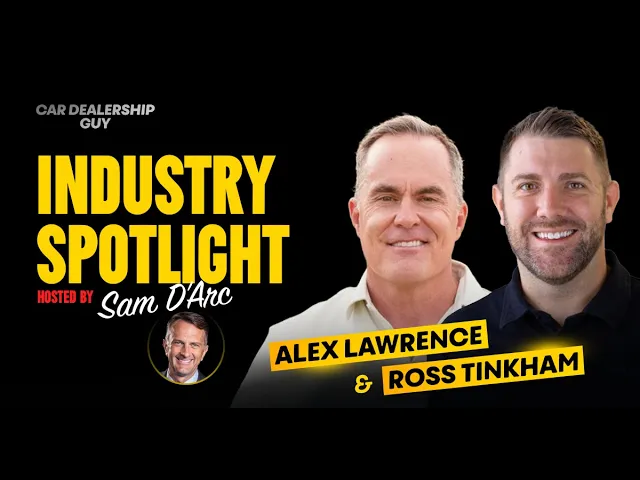
How Robots Are Changing Car Sales – And What's Next
Summary
Alex Lawrence, CEO of Utah-based used-EV dealer EV Auto, joins host Sam D'Arc and Podium's Ross Tinkham to explain how he built a business that sells nothing but used EVs, moves roughly 100 cars a month out of a single lot of about 60 vehicles, and has become an early, hands-on adopter of conversational AI. Lawrence describes EV Auto's AI agent, which he calls Glow (Podium's underlying product is named Jerry), as an after-hours and overflow teammate that answers texts in the dealership's own casual, emoji-friendly voice, and credits it with millions of dollars in incremental sales without shrinking his sales team.
Tinkham explains that Podium's AI is model-agnostic, currently built on OpenAI but swappable as better models emerge, and is strengthened by years of conversational data across roughly 7,000 dealerships. He urges dealers to treat rollout as a three-month cycle of integration, observation, and tuning rather than a one-time setup, since every store's voice and customer base differ. The conversation also covers AI's effect on headcount growth, the coming shift toward voice AI for inbound and outbound calls, and fixed ops as the next big frontier for AI in dealerships.
Key takeaways
EV Auto sells around 100 cars a month from a roughly 60-vehicle lot, turning its entire inventory over in under a month.
Podium's AI BDC product has grown from a roughly 50-dealer beta to more than 1,000 dealers using it, drawing on conversations from about 7,000 partner dealerships.
Ross Tinkham recommends dealers plan on a three-month cycle of reviewing AI conversations and refining responses after initial CRM and DMS integration is set up.
About the Host & Guests

Host
Sam D'Arc
COO, Zeigler Auto Group
Sam D'Arc is chief operating officer of Zeigler Auto Group, a multi-state dealer group in the Midwest, and hosts Industry Spotlight on the Car Dealership Guy podcast network, along with Zeigler's Driving Vision podcast. He has more than 30 years in automotive, including nearly two decades with a global direct-insurance provider delivering F&I and insurance solutions to large dealer groups.

Guest
Ross Tinkham
VP & General Manager, Automotive, Podium
Ross Tinkham is Vice President and General Manager of Automotive at Podium, where he leads the company's work with franchise dealers, dealer groups, and OEM programs. At Podium he has held roles spanning automotive sales, OEM and channel partnerships, and go-to-market partnerships. He speaks regularly on AI adoption in dealerships, including at the 2026 NADA Show.
Guest
Alex Lawrence
CEO & Co-founder, EV Auto
Alex Lawrence, PhD, is CEO and co-founder of EV Auto, a Utah-based dealership specializing in used electric vehicles that he started in 2020 and that now operates locations in Utah and Tennessee. He is also a professor at Weber State University, where he teaches sales, entrepreneurship and AI tools for business, and has been featured in The Wall Street Journal and on CNN.
Timestamped Chapter Markers
00:00 – Introduction
00:32 – Who is Alex Lawrence, the EV dealer?
00:56 – How did EV Auto first start?
02:51 – What challenges has Alex Lawrence faced?
05:08 – What is unique about EV service?
06:46 – How profitable is remote EV service?
10:03 – How does EV Auto create unique experiences?
12:14 – Podium segment begins: Ross Tinkham joins
13:50 – How is AI used at EV Auto?
16:32 – What is the future of AI in dealerships?
19:44 – What does "training" an AI agent mean?
24:29 – How is AI's sales impact measured?
26:36 – What makes Podium's AI different?
29:47 – Has AI slowed headcount growth?
30:50 – What other AI tools are dealers using?
34:30 – What's next: voice AI and fixed ops
Who is Alex Lawrence, the EV dealer?
Sam D'Arc: Hey everyone, welcome to the Car Dealership Guy Industry Spotlight. I'm your host, Sam D'Arc. Today we've got an episode and a topic I'm super interested in as a franchised auto dealer. We're talking with a used dealer who's all in on EV — sells nothing but — and says that focusing on this one niche is his secret to success. You'll also hear about the robot he calls Glow that helps him sell cars. Yep, you heard that. We'll dive into whether AI robots can lie and what to do about that, and how he's using a Tesla truck and trailer to bring mobile EV service straight to his customers.
Sam: Today I'm joined by Alex Lawrence, CEO of Utah-based EV Auto, and Ross Tinkham, VP and General Manager of Automotive at Podium. Let's jump in.
[Sponsored by Podium] Today's episode is brought to you by Podium. Thanks to them for supporting the show.
Sam: Alex, I'm super fascinated as I read about you and your organization. You have multiple EV used auto dealerships in Utah — you sell EVs and nothing but EVs. Tell us a little bit about your group and how you got into this.
Alex Lawrence: Yeah, thanks Sam, appreciate it. So the genesis of where we're at now actually started as a marketplace. We own some good domains.
How did EV Auto first start?
Alex: We own EVcars.com, for example. I actually come from the technology world — not a car guy, other than that I like cars — so I had no experience in the car business at all. I just had trouble finding a used Tesla. This was about five years ago next month, and I started thinking about building a marketplace for people to buy and sell used EVs, which five years ago was nothing like it is now. So it started down that path. With my background as an entrepreneur, in my previous businesses I was either the customer or intimately connected to the customer. In this case, I was the customer, but not the paying customer.
The paying customer in our business model was car dealers — they'd pay to list their cars. So I wanted to learn how they worked, the vocabulary, the tools, so I'd have some understanding. My co-founder had an old dealer's license, so we dusted that off, signed up for a few different products, watched some YouTube videos, bought a car at Manheim in California, got it shipped here, and sold it. We did that for about a year and a half. As I kept doing that, it struck me — wait a minute, there's a real opportunity here to build an actual car dealership.
Sam: So when did you open your first brick-and-mortar, above and beyond the domain?
Alex: The first brick-and-mortar location — there are rules associated with having a dealer's license here in Utah, so we had a building, but it wasn't really much of a car dealership. We leased a pretty rough little space about ten minutes from my house. That was about two and a half years ago. Then we started looking for a location we could own and build, so we bought a piece of ground and built a new building, among a few other things we can talk about.
Sam: So in a lot of ways you've done it in reverse — you started with the online domain, started with the marketplace, and then went to brick-and-mortar.
What challenges has Alex Lawrence faced?
Sam: As you've opened up a physical location, what has surprised you most about the auto business? Has anything hit you where you thought, this was different than I expected, given your entrepreneurial background and other successful businesses?
Alex: I wouldn't say there's been a lot of surprises, though I've learned a ton and continue to — some of it more painful than others. I've been a car buyer my entire adult life, I've bought a lot of cars, and I love cars, so I had a generic understanding of how the process worked. But I've learned a ton. Understanding how shipping works, inventory management, the financing side — the lending and loans and how that relationship works, and all the rules associated with it — has been really interesting. It's been a very steep learning curve. But on the positive side, I've been a little surprised at how well we've done. I don't mean that arrogantly, but we've beaten all of our goals, and I keep worrying that's going to end. That's been a bit of a surprise, honestly.
Sam: A lot of our listeners would acknowledge the timing of your getting into this was probably pretty fortunate — coming in around COVID, when EVs were in high demand and there wasn't enough supply. What do you think was the one key to your success? Is there a twist that's allowed you to be so successful in this space?
Alex: It's been a bumpy road, let me be clear — there was a period where people lost their shirts on EVs, the most volatile, highest-appreciating car in the history of automobiles. But it's very clear to me what the main reason is: we've been hyper-focused on only this small niche of cars and have never deviated from that. Being right in touch with the market, the trends, and changes in customers — not doing anything outside of that — has helped us predict some of what's happened and react to it quicker than others who kind of dabble in it.
Sam: What do you think the automotive industry as a whole gets wrong about EVs and the demand?
Alex: It depends on the area and the location — some dealers have very legitimate gripes, and I'd be upset too if I were an OEM getting shipped cars I knew weren't going to sell. I think the biggest surprise is probably how much money you can make on the service side, because everybody thinks EVs are not great on the service side.
What is unique about EV service?
Sam: That's fascinating — I did some research on you and your company, and right on your site you have remote service for EVs, with a Tesla truck and a trailer. A lot of people in this industry would say, what are the intricacies of service for those vehicles? What does EV service look like in your world?
Alex: Their hypothesis is that EVs don't need to be repaired — it's a value proposition to the customer that you don't have to repair these things very often, there aren't moving parts and fluids and stuff. And that's true.
Sam: That's not true?
Alex: No — well, it is true. It's true that there's less that can go wrong, less that can break — there just aren't as many physical parts, no gears and fluids, so it's not as hard on the car. That is actually true. It's exaggerated by some, for sure, but it is true. They're not going to need service every three months — that frequency isn't there, that's absolutely a fact. But when they are repaired, it's very labor-heavy, and that's where the margin is — parts are fine, but it's the labor. The other thing people aren't really thinking about is the Model Y is on track to become the number one selling car in America for the year — I think they're predicting that by the end of November. It's already the number one selling car in the world. These cars are going to come out of warranty, and when they do, the marketplace will go to whoever can fix them. There's a lot of them on the road, so it's a big customer base that people are ignoring. That might be the real surprise — there's real money to be made on the service side of EVs, but you can't dabble in it. If you dabble, you're going to potentially get burned.
How profitable is remote EV service?
Sam: Is remote EV service profitable? Are you making money at it as you enter into it?
Alex: Yes, we're aggressively expanding that part of our business. Part of that is because we have a really strong reputation in our market — we're the highest-rated Google dealer, new or used, in the state of Utah. We've got a perfect five-oh, not a single non-five review, out of three hundred-some reviews. Now somebody will probably watch this and go give us a one-star, which happened last time I was on a big podcast. But we've got a lot of positivity built up around our brand, which made us busy from day one — we've been booked solid from the minute we launched it. It's been very good business for us, and one we're going to keep aggressively expanding.
Sam: How many units do you sell a month?
Alex: This month we should be over 100 units out of this one location. We've only got about 60 on the lot, so we turn our entire lot over in under a month. Our inventory turns are very fast around here — knock on wood.
Sam: How many of these remote service units do you have?
Alex: We only launched our first one about a month and a half ago, and it's already more than a week booked out, so we're going to add a second one. As soon as we get to two weeks out, we add another Cybertruck and another trailer.
Sam: If anybody wants to see photos of this, where can they go see it? I think it's on your Facebook page — it may be on your YouTube page too, right?
Alex: The best place to follow me and what we're doing is either TikTok or LinkedIn. Those are two very different platforms, but we have a pretty good voice in both, and that's where most of our daily content is produced.
Sam: Shifting to our topic today — your goal has been hyper-growth for your dealerships, and you're very niche. You've talked about how that niche focus has led to success in your industry, and you've reinvested over and over again, including in technology, to help multiply your efforts.
What's the biggest challenge in choosing which technology to invest in?
Sam: What has been the challenge as you've looked for different areas to invest for a good return? What are you looking for as a return on those investments?
Alex: I'll say this — here's a surprise, Sam: the number of vendors that approach car dealers is incredible.
Sam: Holy cow — is there a big target on your back?
Alex: My gosh, it's relentless. I didn't realize that going in. I think one of the challenges is just wading your way through so many competing offerings in very similar spaces. For me, the things I think about that I'm looking for — because I'm a technology person before I'm a car dealer — are things that can free up my team to do the things they enjoy most. I've had over a thousand employees over the years, and I learned early on: aces in their places. I want to put people in spots where they really like what they're doing and are really good at it. The more I can use technology to free things up, the happier they are, the better they do, the more cars they sell. I'm always looking for things that can multiply those kinds of skills and efforts. It's not always easy to measure that, but one of the places I can measure it is in turnover — if people are happy, they stay, generally. I'm not naive to the fact that sometimes someone just finds a better opportunity. But in five years we haven't turned anybody over, which is really unusual for this industry. Some of that is culture, but it's also an effort to use tools, including technology, to let people focus on the work they're good at and enjoy.
How does EV Auto create unique experiences?
Sam: So in an EV-only dealership, what does that experience look like? How does the experience you create for your customer depart from a traditional auto dealership?
Alex: I think it departs in a couple of ways. Starting with the online or off-premise communication — we're very attentive to individual communication. We answer our phones quickly, every time, and we respond via text message very quickly. It's personable, it has a personality, it's not generic or boring. Then when they come here, my dealership looks like my art — it's really fun, bright, loud, and cool, and modern. It's all glass garage doors, a big graffiti wall, I've got 985-inch TVs built into a giant TV wall, and just funky stuff with the brick. That's their initial impression. Then when they're in the dealership, they only work with one person from start to finish — there's no F&I backroom person. We can get them in and out of here in 20 minutes if they want. It doesn't have to be a lengthy process. It's all digital, it's all tap-to-sign. And from a sales approach, we don't push back-end product, we don't pre-add any upgrades or customizations to the car. I've been told many times that we're leaving money on the table, and maybe we are. The follow-up is all very digital too. So their interaction is this unique combination of tech that makes it quick, easy, efficient, and digital online, but we've done a pretty good job of simulating our personality through that, coupled with a very authentic, real-world, in-person experience. We think it's pretty different — I know everybody says that, but we think it's a unique way to buy a car.
Sam: How many salespeople do you have at your locations?
Alex: Right now we've got three on the floor.
Sam: And then your younger kids — probably more comfortable texting than having a phone conversation in some cases, since it's so tech-driven?
Alex: Yeah, definitely. They've learned, though, that phone calls are still a good thing for closing the deal, so it's this combination of texting and phone calls, and they're finding that balance.
Sam: So you've created this digital, online experience, and you've tried to find tools and solutions to help amplify that.
How is AI used at EV Auto?
Sam: That actually brings in Podium. So we've got Ross Tinkham, VP and General Manager of Automotive at Podium. Ross, welcome.
Ross Tinkham: Thank you.
Sam: So Alex comes to you and says, hey, we want to create this unique experience in our automotive space — used-car dealer, EV-only — and we want to multiply our efforts. How does Podium come in to help solve that?
Ross: I'll let Alex answer some of that too, but I'll kick it off. We've been around for about a decade but have grown a lot — started as a review-generation solution for car dealers, then started transitioning more into the SMS or messaging space. Then about a year and a half ago we really started down the path of conversational AI. So conceptually, we built this platform for communication, and now on top of that we're beginning to layer various AI agents. Alex joined us on that journey fairly early, while we were in beta, and his needs are a little different than the average OEM dealer we partner with. Alex, it'd be great to hear from you on your journey and partnership on AI with our product team, and anything you think would be interesting to share, given your specific needs.
Alex: I'm very picky about technology given my background. Even though Podium is here in Utah and I've admired them from afar for a while, that didn't mean anything to me in terms of spending my hard-earned dollars on their product. Initially I was using them for Google reviews, texting, and payments — very elegant, all three super simple, always worked, very fair price. I'm not a commercial for Podium, I'm just saying that was a really easy thing for me to choose. My second life — my other life — I'm a college professor, and I actually teach in a sales program, two classes, one of them called Sales Technology. I've been teaching my students to use AI tools since January of 2023 — GPT came out roughly in November of '22, so I was a very early adopter of that technology. I've been watching AI in a variety of spaces and using a lot of tools as they come out — I'm on every beta test list, every new app sign-up, always testing things. One of their product leaders, Jiovan, came to me and said, hey, we're doing this, do you want to beta test some stuff? And I said, absolutely.
It's been a while now. Admittedly, when it first started out, just like every other AI product I've tested, it was okay — it was still learning, and the team was still learning. But it's become a really impressive tool that we use every day, all day, to the point where it's gotten so good at talking the way we want our customers to be spoken to that a lot of times I'll read a response and think, that's better than I would have answered it. It's really got our voice down, and it advances conversations after hours and when we're busy, in ways that I would love a human to.
Sam: As you describe that, that touches on something a lot of the auto industry worries about — we've long thought that at some point AI replaces people in automotive, and we at the Ziegler Auto Group believe that's absolutely not true. You've sort of said, Alex, that AI and technology help get us information so we can create an incredible experience for our customers. I love what you said — I actually read your article in the Wall Street Journal about what you did with your students at Weber State.
Sam: You actually told them, hey, use ChatGPT to cheat — use it to help complete your test answers.
Alex: I didn't say to cheat. I didn't say to cheat. In school, there's a thought that you don't get extra points for collaborating — but in the real world, when we come together to help achieve and accomplish a goal, that's success, that's winning. That's one area where school, I think, departs from business — we want to help each other in business to do our best, and ChatGPT was able to do that with my students.
Sam: So walk us through, for the car folks listening — you say it starts to sound like you. If I'm a customer reaching out to you, where's the first place I see this AI? How does AI meet me, greet me, or help create that experience?
Alex: Let me tie one thing back to what you said first — couldn't agree more. As much of an early adopter of AI and technology as I am, it's not replacing people at my dealership, and it never will. That high-touch, in-person piece is always going to be there. What AI is doing is augmenting what they do and helping them — it's the grunt work, the busy work, the things they don't enjoy, that frees them up for more personal time.
What is the future of AI in dealerships?
Sam: Before you go further — what is it about the car-buying experience that you'd say AI and technology will never completely replace? What is it about buying a vehicle that's still a human experience, in some fashion?
Alex: Let me declare — it can and will replace that for some customers. They don't want to talk to a person, they don't want human interaction, they prefer not to have it, and it's important to provide that for them if that's their choice. It's kind of a shame, in a way — most people like that human connection. The majority of people, because it's the second-largest purchase in their life, want to talk to somebody. They're kind of afraid to, because of the negative stereotypes associated with car-buying experiences, but they still want to. For the vast majority, it's too big of a purchase — they're not buying something from Amazon, even though Amazon has tried that, and I don't think it's working very well with Kia or Hyundai or whoever. But Tesla has made it so you don't ever have to talk to a person if you don't want to. I just think there's always going to be a large customer base that, because of the ticket price, wants to work with a person — and I think that'll always be the majority, the vast majority. It may age out some over time as comfort levels keep getting bigger.
Sam: Maybe, but I think that's decades down the road before that's even a possibility. For now it's essentially a human experience aided and supported by technology, but still person-to-person for that trust. So at your dealership, where's the first place I see AI?
Alex: There's really only one place you see AI with us, and that's via text. Our real-time texting is live during business hours, and it's live 24 hours a day. So while we're open it's only interacting with customers once a certain amount of time has passed — because, Sam, I'm sure you know this too, Ross — there's a certain amount of time where it becomes like the death of a deal, and you don't care who talks to them as long as it's before that time passes. So we've got a timing rhythm where if the phone is ringing off the hook, there are customers in here, and we're not able to be responsive, then — Podium's native name for their product is Jerry, we call ours Glow — Glow at EV Auto will step in and do the things I'd like a person here to do. We've spent over a year now training it, and admittedly it won't take someone else a year — we've been in the beta program.
What does "training" an AI agent mean?
Sam: I've heard this idea — I was at a meeting last week with Chase Bank, and they were talking about how they use these AI tools. They talked about training, saying they believe one day there will be AI agents or bots that are individually trained for a specific task, and the longer they're trained, the better they get at that specific task — it won't be one powerful thing that does everything. Ross, what does training mean? What does that mean in the AI world, and how do we understand that?
Ross: I think this is the cornerstone, really. If you're not using some sort of conversational AI at your dealership, this is a new adventure for you — or maybe you tried something years ago that wasn't today's technology. This is a journey. The way I'd describe it to a dealer is: there are certain tasks AI is quite good at today, like handling first touch on all the leads you spend a ton of marketing money to bring to your website. You're not necessarily there after hours, you can't get in front of them at all times during the day when you're busy. So let's center in on the jobs to be done and where it can drive the highest value. With that said, every operation is unique to a degree — they have their own characteristics, the things they value as an organization, their voice to the customer. The way you'd engage a customer at a Porsche dealership would likely be very different than at a mass-market Honda store, for example. So it can't be a peanut-butter-spread technology that operates the same way for everybody, given those unique characteristics.
That's the learning curve. I'd say our AI is quite strong out of the box — have high expectations. But you're on a journey, and I'd recommend you look at it as roughly a three-month cycle. You get it set up, you get your integration set up with your CRM and your DMS, basic cover-the-bases stuff. But then you're going to watch those conversations happen over time, and you're going to see things you love and things you'd like addressed a little differently. It requires some time investment from the dealer to make it what it can be for them. That's the journey. It doesn't need to take a year — the technology has come a long way since Alex first stepped in working with Podium, it's far better than it was a year ago, period. But you're still going to want to make it your own.
Sam: So the AI he's training to respond via text — is it just his group, or is it segmented? How do you think about that?
Ross: We think about it in terms of jobs to be done. AI BDC is our virtual agent that handles inbound leads, and it's outcome-driven — essentially working to schedule test drives to bring people into the store. But given the uniqueness of what Alex is doing — only selling EVs — things come up in those conversations that, as he trains it, help educate the AI more broadly so it's more applicable to our other customers.
Sam: So how does he train it? Give me an example, Alex — what's a response the AI gave where you said, hey, that's not quite right, and how do you engage with it to help it improve?
Alex: They've got a really elegant bug-reporting system for the AI. To Ross's point, I was one of the very first beta users, so I want to make clear that even in the last three months they've really been iterating fast on this product. Over the last six months or so, the AI struggled with people texting us from out of state trying to get them to come in and do a test drive — and that's just not happening. The way I trained it, to your specific question — there's just a thumbs-up, thumbs-down icon. If you click thumbs-down, a screen pops up with some pre-determined options for what mistake it made, plus a comment box. From my personal interaction with the team, I know their engineering team jumps on that — it doesn't go to some random inbox. They live and breathe for that feedback, then they retrain it. After doing that a couple of times, it didn't make that mistake anymore.
Sam: You mentioned earlier that there are instances where this AI responds better than your team would. Give us an example.
Alex: There was a conversation just yesterday where a customer had questions about the differences between two Teslas. Our voice is very different — I think a lot of OEMs and franchises would cringe if their AI talked to customers the way ours does. It's super chill, relaxed, not slang, not cliché, but very informal and light, uses emojis and stuff. It didn't waste a word — it explained the differences so well that I'd copy and paste that response into anything a human here would give. It's funny, Sam — a lot of times a customer will say, oh, I didn't even know you guys were open, when it's 11 o'clock on a Sunday night. The AI knows to say, we're not open, but we're a small business, we hustle. And it does not lie — if somebody asks, is this a person? It says, no, I'm Glow, I'm an AI agent that works for the company. It just had a really natural conversation that felt authentic.
How is AI's sales impact measured?
Sam: So you said, Ross, it's outcome-based — the goal is to schedule appointments and bring the customer in, in an authentic way. Alex, are you able to quantify the impact? Can you say, hey, this has had X dollars of economic impact on my business?
Alex: There's two things. Again, I'm a little different — I've actually had it shy away from pushing people to come in for test drives unless the customer says certain things. We're a little more laid-back about driving to that tip of the spear on every conversation. Glow is not a high-pressure salesman.
Sam: No, no, and neither are we.
Alex: That's part of why I wanted it to match — though sometimes I think we can be a little more decisive and better closers. One other thing I do, and this may or may not be something Ross's team encouraged, is I actually have an hourly employee who's like an air traffic controller for Podium. During business hours, this person gets paid $25 every time they schedule a test drive. They're using Glow to augment conversations, but during business hours they're also assigning leads to different employees based on location or prior interaction. So I'm very easily able to quantify that, because we know what sales closed as a result of AI augmentation — and I can tell you it's been millions of dollars in sales for us. Another thing that blew me away, Sam, is how expensive some of these tools are. I'm thinking, how are these guys paying tens of thousands of dollars a month for these tools? Podium is really affordable, so the ROI for me is off the charts.
Sam: It's interesting — one of the biggest challenges with a younger sales force, or really any sales force, is keeping them trained on how to engage a customer and get the appointment, since you're spiffing based on an appointment. It's interesting that an AI tool that learns as it goes could become even more efficient than a human at bringing them in, and then hand them the human experience on-site.
What makes Podium's AI different?
Sam: Alex, you said you're shocked by how many vendors there are in the auto industry — my inbox is the same way, probably 90% of it is AI tools reaching out, and I bet 90% of that outreach is itself AI-driven. You're just inundated. One day I'd love to have a bot that responds to all that stuff for me. But Ross, what makes Podium's AI different from all the other tools out there?
Ross: That's a great question. I can speak to our formula, and how we approach it. I can't necessarily speak to how other companies design their AI or what models they use, but here are some core principles that guide us. Number one, we're model-agnostic. We're currently partnered with OpenAI and have been for some time — that model is the highest-quality model we've found in the market. But as this technology develops, if another model would suit our needs better, we'll follow the best model to provide the best experience and conversations for our customers. We work with about 7,000 dealerships, primarily in the US and Canada. So you have the connection with OpenAI, but then you have all the conversations that have been happening for years and years at Podium — we've accumulated a ton of knowledge that we feed in to make it really our own, Podium's own AI. I'd say that's the starting point.
The other piece is feedback from dealers — like Alex mentioned, we take that seriously. We started this year with a handful of about 50 dealers who participated in a beta, and at this point we've got over 1,000 dealers on our AI BDC product. We've learned a lot along the way from them — it's the continued learning, the input from customers, centering on what we feel is the best model to provide the best conversationality. When I get asked what's the difference between what we do and others, to me that has to be your center of gravity. The entire point of an AI tool is to engage, in this context, to the degree of a human or better. If you're using a tool that can't engage to the degree of a human, what is the point of using that tool? There are other ways to evaluate what the right AI solution is for you, but I'd hope you spend time getting validation from the provider — engage with the AI yourself, try it, beat it up, ask it questions. Dealers love to do that, and you get some great ones. Last week we had a dealer group where the owner asked the AI to find a car with a flux capacitor — there was no way it was going to answer that question seriously. And our AI responded, I can tell you're a Back to the Future fan — it recognized the humor, the intent that it was a joke, and worked to gently guide the conversation back to getting that person the car they were actually looking for.
Sam: And moved them right over to an EV.
Ross: That's right — yes, we do have that.
Has AI slowed headcount growth?
Sam: How has this helped you multiply your business, Alex? I assume it saves a little in headcount, but it sounds to me like it doesn't kill headcount — it just multiplies your efforts.
Alex: Yeah, we're spending a lot of time and energy trying to increase the traffic to our business, whether that's online, on the phone, or in person. For me it's not decreasing headcount — I think it's slowing the increase. I'm able to do more with the same, and make sure that as we get busier, the response time and quality of responses stays really good. For me, it's inexpensive insurance that I don't have to worry about. I don't worry about how it talks to customers, I don't worry about how it represents our business, because I watch it all day, every day, and I'm very comfortable that it's a well-trained employee. Other than the sales I can connect to it, there's the low turnover, which I think it contributes to — though it's not the main reason, that's more about how people are treated and the environment they work in. But our customers just feel like we are crazy responsive, and authentically so. It still surprises me a little, Sam, how few people wonder whether it's an AI agent, even at strange hours outside normal business hours. If it sounds conversational, sounds human, they don't really get it. We're responding at 2am on a Saturday night, and I'm surprised they're not saying something — or maybe they do know and just aren't saying anything.
What other AI tools are dealers using?
Sam: As we get toward the end, I'd love to ask Ross one of the last questions, and this may be unfair — Alex talked about how many vendors are out there. For somebody like me, who's had conversations with your team before, I have a tough time taking anybody too seriously, because I want to see it work first. So even outside of Podium, what are some of the best AI-driven tools out there? And Alex, you're super forward-thinking — what are you thinking about next? You've implemented this as a tool to communicate with customers, you're growing your EV business — what are some of the next tech-related things you're thinking about, or different ways you're thinking about your business to continue to grow and scale it? We've got 41 stores across four states and a ton of employees, and actually, I'll tell you a quick anecdote — I went through Dealer Academy, and one of the things you do in NADA's Dealer Academy is call your own store and try to schedule a service appointment. They record it and give you a tough scenario — I'm new to town, I'm a doctor, my car broke, I want to come in 15 minutes after you close, do you have a loaner car? As we went around the room listening to how different dealers' service departments answered the call, it was shocking to everybody, because you'd hear people, 15 minutes after close, say, hey, there's no way we can do that, we don't have a loaner car — human beings are flawed sometimes, and sometimes they'd push the business away. I'd be fascinated to see how AI would adapt, and maybe even do better than a human. So what other tools are you seeing out there, Ross?
Ross: Yeah, that's a great one. My mind goes toward some of the players on the fixed-ops side — focused on how we help drive efficiency on the service side of the business, or making sure that every time the phone rings, there's someone there to answer it, whether AI or human. If you're looking for specific names, there are companies like Stella AI, Broadly AI, or Numa — small upstarts purely focused on fixed ops. I'm more on the sales-AI side, so I'd say the larger players in the market would be the Podiums, the Impels of the world, for sure, but there are new ones popping up every day too. The good thing about that is it forces all the incumbents to either do better or lose market share.
What's next: voice AI and fixed ops?
Ross: But I do think, again, on the service side of the business, that's really where we're headed next, going into next year, and there's a ton of opportunity there. The other really interesting piece is that today we're mostly talking about AI through asynchronous communication — texting, email. Voice AI that sounds like a human is getting there, but it's still not quite there. I do think, looking toward next year, there's likely an inflection point — I don't know if Alex would agree, but that appears to be where we're heading. You could see a day where the person answering the phone, the back-and-forth communication before someone's sitting in front of you, would be all AI-driven.
Sam: You could actually see a day where that back-and-forth before they're sitting in front of you would be all AI-driven?
Ross: Yeah, for sure, and there are people doing that today. Again, my call-out is that you can tell it's not a person just yet. With messaging, it's very hard to distinguish. And I love Podium's standard, as you'd put it — it's got to be as good as a human or better in order to be customer-facing, because that's the standard we've got to deliver on.
Sam: Alex, last question as we wrap up — what are some of the other things you're thinking about? You've found this Glow tool, and it's been advantageous for your company. What are some of the next things you're thinking about to continue to grow your business?
Alex: Ross talked about it — conversational voice AI is going to be really cool when it works. I think more so for outbound calls than inbound. Car salespeople enjoy inbound because it's a fresh lead versus dialing old ones — I don't think anybody really loves doing that, though the best ones do, because they know there's gold in there. But if a really good call-leads-all-day tool comes out, especially since the bar is a little lower there, I think that'll be huge. I was actually part of a beta test in a different industry — outbound calls for debt collections — and it got really good. The percentage of dollars collected completely by an outbound AI agent was impressive. I think you're going to see some really cool stuff there. Like I said, I'm more interested in it for both outbound and inbound.
Sam, I bet this is something you've thought about too — my dream is to have an AI that can just answer difficult questions for me. I want it to tell me about my inventory, tell me about the market, tell me different metrics, accountability tools, measurements, analytics — I just want to ask it a question. I want it to be like Siri, except Siri sucks — I want it to be good Siri. I won't even get into how bad Apple Intelligence is, it blows my mind how bad it is. But I want something like an incredible data analyst, a CFO-type thing I can riff with and go back and forth with. I can't wait for that, as a business advisor, if you will, to my company.
Sam: How far down the road is that, Ross?
Ross: That's a good question — I don't know if I have a great answer, unfortunately. Hopefully next year.
Sam: Yeah, it is amazing how fast it's all evolving. If you haven't looked at AI, if you haven't looked at some of these technology solutions recently, now is a good time to get familiar with it again. We appreciate you being here, Ross, with Podium, sharing Glow, this cool tool, with us. And Alex, very cool what you're doing in the EV space as you continue to grow — fascinated not only by this AI tool, but also by your service business and your efforts to do mobile service in the EV space. Thank you both, and we appreciate you being here with us today.
" width="1420.5180000066757px"><path d="M 0 0 L 1420 0 L 1420 296 L 0 296 Z" fill="transparent" height="296px" id="nEUrsAEtA" transform="translate(0.518 9.913)" width="1420px"/><path d="M 1101.408 94.796 L 1162.108 94.796 C 1162.708 101.291 1163.218 106.75 1164.008 115.715 C 1182.088 95.792 1202.098 86.826 1226.818 90.094 C 1238.317 91.244 1249.326 95.332 1258.788 101.966 C 1268.28 108.62 1275.911 117.591 1280.958 128.027 C 1311.458 88.938 1342.858 79.295 1378.608 97.147 C 1390.369 102.775 1400.329 111.571 1407.368 122.546 C 1414.426 133.558 1418.299 146.309 1418.558 159.387 C 1420.848 206.206 1419.188 253.185 1419.188 301.12 L 1358.558 301.12 L 1358.558 258.365 C 1358.558 233.78 1359.078 209.194 1358.008 184.649 C 1356.858 158.948 1347.168 146.994 1329.408 146.317 C 1310.938 145.6 1296.428 157.673 1293.818 181.661 C 1290.848 210.589 1291.678 239.916 1291.008 269.084 C 1290.768 279.006 1291.008 289.007 1291.008 300.443 L 1229.388 300.443 C 1229.388 268.924 1229.628 237.326 1229.388 205.768 C 1229.388 194.531 1230.378 182.258 1226.338 172.337 C 1222.308 162.415 1213.128 148.867 1205.188 148.11 C 1194.468 147.114 1179.828 154.206 1172.318 162.734 C 1165.438 170.703 1163.818 184.729 1163.418 196.205 C 1162.348 230.592 1163.058 265.019 1163.058 300.722 L 1101.408 300.722 Z M 987.455 300.441 C 986.941 293.906 986.466 287.49 985.754 278.366 C 962.024 309.446 931.768 312.912 900.207 300.281 C 867.578 287.251 855.673 258.323 854.803 225.171 C 853.695 182.256 854.526 139.262 854.526 95.072 L 916.264 95.072 C 916.264 118.582 916.066 141.613 916.264 164.604 C 916.264 182.495 916.66 200.466 917.727 218.277 C 918.756 235.371 926.824 247.565 944.938 249.278 C 963.052 250.991 976.183 242.624 981.364 225.37 C 984.657 213.266 986.319 200.777 986.308 188.233 C 986.98 157.83 986.506 127.387 986.506 95.391 L 1047.608 95.391 L 1047.608 300.361 Z M 803.391 300.881 L 744.065 300.881 L 744.065 95.633 L 803.391 95.633 Z M 803.232 54.906 L 743.907 54.906 L 743.907 0.316 L 803.232 0.316 Z M 629.089 0 L 629.089 110.095 C 572.928 79.932 532.31 84.515 500.234 123.524 C 466.458 164.605 465.904 229.913 499.285 270.955 C 506.713 280.676 516.027 288.798 526.669 294.834 C 537.285 300.856 549.013 304.661 561.142 306.02 C 587.522 309.009 609.195 299.087 628.18 278.805 C 629.129 288.567 629.722 294.744 630.276 300.521 L 690.234 300.521 L 690.234 0 Z M 584.279 249.836 C 556.593 249.836 537.649 228.36 537.847 197.479 C 538.044 166.598 557.108 145.957 585.307 146.395 C 611.845 146.754 631.383 168.351 631.7 197.638 C 632.016 226.925 611.727 249.677 584.279 249.638 Z M 148.037 12.277 C 99.35 4.746 49.161 6.698 0 4.507 L 0 301.362 L 63.597 301.362 L 63.597 209.954 C 88.909 208.799 111.453 209.517 133.443 206.409 C 156.213 203.687 177.278 192.891 192.872 175.955 C 208.466 159.018 217.57 137.044 218.555 113.965 C 221.087 66.029 192.808 19.17 148.037 12.277 Z M 153.02 109.542 C 152.565 119.234 148.447 128.392 141.5 135.166 C 134.584 141.91 125.344 145.745 115.685 145.882 C 99.35 146.639 82.976 145.882 65.1 145.882 L 65.1 69.775 C 84.044 69.775 103.108 67.942 121.657 70.293 C 126.279 70.785 130.757 72.192 134.829 74.433 C 138.911 76.679 142.507 79.712 145.409 83.356 C 148.32 87.01 150.482 91.201 151.773 95.69 C 153.066 100.186 153.463 104.893 152.941 109.542 Z M 338.829 89.813 C 324.732 89.898 310.792 92.777 297.815 98.285 C 284.813 103.805 273.03 111.839 263.142 121.926 C 253.226 132.04 245.393 144.003 240.087 157.135 C 234.77 170.292 232.078 184.362 232.162 198.553 C 232.244 212.743 235.1 226.78 240.571 239.874 C 246.03 252.942 254.003 264.811 264.037 274.807 C 274.043 284.775 285.919 292.668 298.984 298.034 C 312.025 303.388 325.998 306.102 340.095 306.019 C 400.963 305.78 448.225 258.721 448.423 198.155 C 448.542 136.672 400.804 89.454 338.829 89.813 Z M 340.688 247.843 C 315.257 248.281 294.256 226.525 293.583 199.031 C 292.911 171.537 314.545 147.231 340.174 147.231 C 365.13 147.231 385.617 169.625 385.894 197.478 C 386.171 225.33 366.514 247.365 340.609 247.843 Z" fill="rgb(254, 254, 254)" height="307.13419463695845px" id="OhFGo_EHq" transform="translate(0 0)" width="1419.7693369032306px"/><path d="M 540.511 74.99 C 524.515 74.99 512.872 64.967 512.872 48.06 L 512.872 47.25 C 512.872 30.544 524.717 19.71 540.106 19.71 C 553.774 19.71 565.924 27.71 565.924 46.642 L 565.924 50.692 L 527.754 50.692 C 528.159 59.5 532.918 64.562 540.916 64.562 C 547.7 64.562 551.041 61.626 551.952 57.172 L 565.822 57.172 C 564.101 68.612 554.989 74.99 540.511 74.99 Z M 527.957 41.68 L 551.648 41.68 C 551.142 33.683 547.092 29.835 540.106 29.835 C 533.525 29.835 529.071 34.189 527.957 41.681 Z M 475.019 73.876 L 455.681 20.926 L 471.374 20.926 L 484.03 58.79 L 496.584 20.925 L 510.758 20.925 L 491.522 73.875 L 475.019 73.875 Z M 432.399 73.876 L 432.399 20.926 L 446.978 20.926 L 446.978 73.876 Z M 447.254 0 L 432.123 0 L 432.123 13.572 L 447.254 13.572 Z M 413.441 74.887 C 402.304 74.887 396.331 69.217 396.331 58.182 L 396.331 31.352 L 389.548 31.352 L 389.548 20.924 L 396.331 20.924 L 396.331 9.484 L 410.91 9.484 L 410.91 20.924 L 422.047 20.924 L 422.047 31.352 L 410.91 31.352 L 410.91 56.866 C 410.91 61.118 413.036 63.143 416.782 63.143 C 419.01 63.143 420.63 62.839 422.351 62.13 L 422.351 73.47 C 420.326 74.178 417.39 74.887 413.441 74.887 Z M 356.42 63.853 C 364.621 63.853 369.379 57.779 369.379 47.756 L 369.379 47.046 C 369.379 36.923 364.621 30.848 356.42 30.848 C 348.321 30.848 343.461 36.72 343.461 46.844 L 343.461 47.654 C 343.461 57.779 348.118 63.854 356.42 63.854 Z M 356.319 74.99 C 340.525 74.99 328.477 64.46 328.477 47.958 L 328.477 47.148 C 328.477 30.544 340.525 19.711 356.42 19.711 C 372.316 19.711 384.262 30.341 384.262 46.844 L 384.262 47.654 C 384.262 64.36 372.214 74.99 356.319 74.99 Z M 238.283 73.877 L 238.283 20.926 L 252.963 20.926 L 252.963 29.026 C 255.596 24.064 261.265 19.711 269.162 19.711 C 276.148 19.711 281.413 22.647 283.944 28.924 C 288.196 22.546 295.081 19.711 301.763 19.711 C 311.584 19.711 319.177 25.887 319.177 39.96 L 319.177 73.877 L 304.598 73.877 L 304.598 41.58 C 304.598 34.796 301.561 31.759 296.296 31.759 C 290.626 31.759 286.07 35.404 286.07 42.592 L 286.07 73.877 L 271.491 73.877 L 271.491 41.58 C 271.491 34.796 268.352 31.759 263.189 31.759 C 257.519 31.759 252.963 35.404 252.963 42.592 L 252.963 73.877 Z M 200.599 63.853 C 208.799 63.853 213.558 57.779 213.558 47.756 L 213.558 47.046 C 213.558 36.923 208.799 30.848 200.599 30.848 C 192.499 30.848 187.639 36.72 187.639 46.844 L 187.639 47.654 C 187.639 57.779 192.297 63.854 200.599 63.854 Z M 200.497 74.99 C 184.703 74.99 172.655 64.46 172.655 47.958 L 172.655 47.148 C 172.655 30.544 184.703 19.711 200.599 19.711 C 216.494 19.711 228.441 30.341 228.441 46.844 L 228.441 47.654 C 228.441 64.36 216.393 74.99 200.497 74.99 Z M 157.068 74.887 C 145.931 74.887 139.958 69.217 139.958 58.182 L 139.958 31.352 L 133.174 31.352 L 133.174 20.924 L 139.958 20.924 L 139.958 9.484 L 154.537 9.484 L 154.537 20.924 L 165.674 20.924 L 165.674 31.352 L 154.537 31.352 L 154.537 56.866 C 154.537 61.118 156.663 63.143 160.409 63.143 C 162.636 63.143 164.256 62.839 165.977 62.13 L 165.977 73.47 C 163.953 74.178 161.016 74.887 157.068 74.887 Z M 93.355 74.99 C 83.028 74.99 75.334 68.915 75.334 55.045 L 75.334 20.925 L 89.913 20.925 L 89.913 53.02 C 89.913 60.208 92.849 63.65 99.126 63.65 C 105.302 63.65 110.162 59.804 110.162 52.008 L 110.162 20.926 L 124.741 20.926 L 124.741 73.876 L 110.162 73.876 L 110.162 65.574 C 107.428 70.94 102.062 74.99 93.355 74.99 Z M 0 73.876 L 23.792 1.486 L 45.155 1.486 L 68.644 73.876 L 51.534 73.876 L 46.572 57.778 L 20.35 57.778 L 15.39 73.876 Z M 33.512 14.85 L 23.894 46.134 L 43.029 46.134 Z" fill="rgb(255, 255, 255)" height="74.99000044250488px" id="QMlTFlhjs" transform="translate(853.5 6)" width="565.9240092773438px"/></g></svg>)