
How Two Mormon Missionaries Built a Multi-Billion Dollar Empire (+ The AI Playbook Behind It)
Summary
Podium co-founders Eric Rea and Dennis Steele sit down with the Car Dealership Guy podcast to tell the origin story behind their AI platform, now used by 4,000 auto dealerships for reviews, texting, and voice-based customer service. They recount their first dealership pitch, where a GM who'd just been shown his bad Google reviews wrote a check for the entire year on the spot, a moment that convinced them dealerships, not the tire shops Podium started with, would build the company. From there, they walk through how AI agents like Jerry, their BDC agent launched in 2023, and their newer Operator and Rainmaker tools are replacing the average dealership's bloated, twenty-tool software stack.
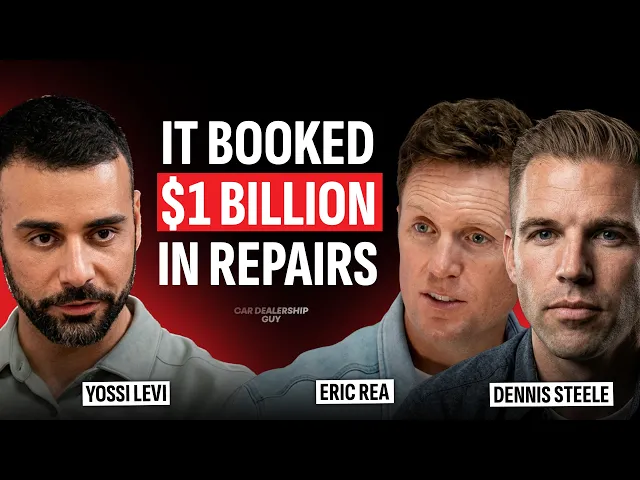
The conversation gets concrete about results: a 700-location collision repair network now lets Podium's voice agent handle 61% of its after-hours calls, putting it on pace to help book $1 billion in repairs this year with a customer satisfaction score of 96%, higher than the network's own human call center. Eric and Dennis also explain why they'd tell young people to learn to use AI agents instead of learning to code, and how Operator can turn a vague management request into a finished outreach campaign in under ten minutes. For dealers wondering how much of their stack AI will actually replace, this episode lays out where Podium thinks the industry is headed.
Key takeaways
Podium's first big dealership pitch in 2014 ended with the GM, after seeing his dealership's 3.5-star Google rating, writing a check for a full year on the spot, convincing Eric and Dennis to pivot from tire shops to dealerships.
A 700-location collision repair network's voice AI now handles 61% of after-hours calls with a 96% customer satisfaction score, and is on pace to help book $1 billion in repairs this year.
Podium's Operator agent turned a request to find 100 lapsed customers across 37 dealership locations into a complete, ready-to-run outreach campaign in under 10 minutes.
About the Host & Guests

Host
Yossi Levi
Founder & CEO, Car Dealership Guy
Yossi Levi is the founder and CEO of Car Dealership Guy (CDG) and host of the Car Dealership Guy Podcast, which features interviews with dealers, operators and industry innovators. He grew up working in his family's dealership and in 2018 launched Gettacar, a digital used-vehicle sales platform. He started CDG as an anonymous social account in 2021 and revealed his identity at the 2024 NADA Show.

Guest
Eric Rea
CEO & Co-founder, Podium
Eric Rea is the CEO and co-founder of Podium, which he started with Dennis Steele in 2014 to help local businesses build their online reputation and has since grown into an AI platform for customer communication, leads, and payments. Before Podium, he worked as a software engineer at the International Atomic Energy Agency. He studied information systems at Brigham Young University.

Guest
Dennis Steele
Co-founder, Podium
Dennis Steele co-founded Podium with Eric Rea in 2014 and has served as the company's Chief Strategy Officer. He came to Podium from a marketing and communications background, and he and Rea attended a coding boot camp together after launching the business to better understand the product side. He is a graduate of Brigham Young University.
Timestamped Chapter Markers
00:00 – Introduction
00:34 – AI replaces the entire dealership stack
03:21 – Don't learn to code, learn agents
04:58 – How founders stay friends for 13 years
08:47 – Door-to-door tactics sold dealerships
09:56 – Reading bad reviews closed the deal
14:14 – Jerry launched in 2023 and never left
16:25 – BDC agent lifted show rate 40%
19:08 – A 700-location collision network bets on voice AI
21:19 – Voice AI completed 87% of bookings
27:51 – A $5K-a-month tool just pulled DMS data
30:39 – Operator found lapsed customers in 10 minutes
37:44 – Default state of any company is stillness
43:19 – Customization has no limits with Operator
47:42 – Rainmaker finds and scales winning agents
51:02 – Closing thoughts and sponsor thanks
Who are Eric Rea and Dennis Steele, and why does this episode matter?
Eric Rea: If you're in management at a dealership, you have this idea: hey, we should reach out to like a hundred people. Now you have to decide, do I want to tell my team to do this? Because if I do this, I can't do that, and that's probably higher priority because this is dealing with the customers coming in right now. In less than ten minutes, Operator comes back. Here's everyone, here's all the details, here's where it pulled it, here's the details of last service, where they lapsed.
Dennis Steele: Unbelievable.
Eric: Yeah, it makes it so much easier.
Yossi Levi: Today I'm joined by Eric Rea and Dennis Steele, co-founders of Podium. Together they built one of the biggest software companies serving local businesses, but they believe the next chapter could completely reshape how dealerships operate. The average dealership today runs on twenty-plus disconnected tools. Eric and Dennis think that much of that stack is about to disappear, replaced by AI agents that make calls, follow up with customers, and execute real workflows. So what happens when AI stops being another tool and starts replacing the actual stack? Welcome to the Car Dealership Guy podcast.
How is AI about to replace the dealership's software stack?
Eric: I think the next five years are going to see more SMBs built than at any point in history. For anyone not in the game, SMB just means small business. It's easy to start a business now.
Yossi: It's easy to start a business now, but then my point is, can you actually get it to revenue?
Eric: I don't know. We'll see. Will there be anybody to buy anything?
Yossi: Exactly.
Dennis: I don't know, man, it's crazy. We were just talking with a podcast guy and he's automated the whole business. He says he's not even going to come into work anymore.
Yossi: I feel like if everyone can build it and start it, then where does the value move? Obviously I see it in my own business, it moves to distribution.
Eric: Right, because if I had a dollar for everyone who reaches out to us with a vibe-coded app who thinks it's the next big thing. I'm sure one in a hundred is actually good, or one in ten, but a lot of them, you could spin up in fifteen minutes. It's actually gotten even easier before AI. It was still kind of hard before AI, but it was way easier five years ago than it was fifteen years ago.
Dennis: Mhm.
Eric: But what we've learned over twelve years is that software is half the battle, maybe not even. You can have the best software in the world, and if you don't know how to acquire customers, build a brand, and serve people, that's probably the most important thing we've learned.
Dennis: It doesn't matter.
Eric: Now, if you don't have good software but you have all those things, it also doesn't matter. The journey of Podium is my dad's tire shop. Dennis and I built a reviews app to help businesses get reviews. We realized car dealerships were going to pay us more than tire shops, so we flipped, and now fifty percent of our revenue is automotive dealerships. We built all these products over time, and now we're selling agents into these businesses, and the service matters so much.
Dennis: A ton, dude. If we suck, we're gone.
Eric: If you suck, people come to me.
Dennis: Yes. And it's not even just about the agent. If the agent's not working, that's one thing, but it's about whether the service isn't good.
Should the next generation learn to code or learn to use AI agents?
Yossi: Of course. I don't think you guys have college-age kids yet, but would you encourage your kids to go learn how to code in the current environment?
Eric: No.
Dennis: No, not code.
Yossi: Wow. I think it's quickly shifting into just learning how to use agents. Agents are the thing that's actually doing the work, and there's a barrier.
Eric: By the way, that's crazy. You guys are the epitome of Silicon Valley guys. I know you didn't grow up in California, but it doesn't matter, you're Y Combinator, West Coast, and you responded very quickly. You're like, I would not tell them to go learn how to code.
Eric: For the last ten years, since I started Podium, any young person who asked me what they should do in college, I'd say, do you like math? And if they said yes, I'd say software engineering. That was my default answer.
Yossi: What do you recommend now?
Eric: I think it's figuring out how to use AI the right way, how to channel that to your benefit. Even in the example you gave, of oh, I can vibe code that real quick so it's not that valuable, what we found is that even if you could make it yourself, it doesn't mean you're going to know how to use it and implement it. So I think really understanding not just how to do something on a surface level, but how that's going to change the way everything works, matters more.
Yossi: You guys have been on this journey for a long time, and I want to talk about what's new right now, because each time we have a discussion you tell me, here's what's new, here's what's changed. I know you meet with dealers very frequently in person, so you have a strong pulse on the industry. But let's talk about the two of you for a second. I asked you this morning where you stayed, and you said the hotel, and you got a workout in together. And it hit me, because you guys have been doing this for thirteen years. I say this sarcastically, but how do you guys not hate each other already? Thirteen years, and you're telling me you got a workout in together this morning. How have you been able to keep nurturing this partnership and scaling the business?
How have Eric and Dennis stayed friends and partners for thirteen years?
Yossi: If I'm not mistaken, you're the fastest company to scale to a hundred million in ARR of agent revenue. That's what I read.
Eric: I like that. I like it.
Dennis: Is it agent revenue?
Eric: Yeah, I think so. I'd guess there are probably faster ones for B2C consumer apps, but for B2B, it's real ARR, annualized recurring revenue, times twelve. A lot of these companies take last month's revenue and multiply it by twelve, there's no contract, nothing, it could go to zero the next month. Ours is actually legitimately ARR. It's legit.
Yossi: Okay, so in other words, in simple terms, your product is being adopted faster than ever before.
Eric: We have four thousand auto dealerships using Jerry today.
Yossi: Four thousand?
Eric: Four thousand. And how do we not hate each other, is that the main question?
Yossi: How do you not hate each other already?
Eric: When you look at the phases of Podium, with the AI era we had to basically refound the business, and that added so much motivation and excitement. If you'd asked me ten years in, are you going to be as excited as you were on day one of starting the company, I'd have said probably not. But we didn't know AI was coming, and it's so revolutionary. What else would we be doing?
Dennis: We talked about this last night at dinner. This is the most exciting thing you can be a part of. We've already built a lot of things that roll right into it, and in the last few years it's been the most exciting part of the whole journey, because we had to basically rebuild the business, rebuild every operation within our own company, and then figure out how to take this technology and serve it up to everyone we've been serving all these years. And how we met, and how we became friends and then business partners, is probably important too. We met at BYU. I was recruiting Dennis to sell ADT alarms door-to-door with me in Southern California.
Yossi: I love it.
Eric: It's a Mormon mission thing. You learn sales skills, you learn door-to-door, and then a lot of people go out and sell solar or alarms or pest control. So we went out in Orange County, California, and usually you just go by yourself and knock a hundred doors a day, and you can maybe sell one.
Yossi: Wow.
Dennis: Or if you sell one every other day, you'll still make good money. You used to make five hundred dollars for selling an alarm. So if you're a college student, you go out six days a week for a hundred days, and if you sell one a day, you can make fifty thousand dollars in a summer.
Yossi: Which, fifteen years ago, that's a lot of money.
Dennis: That boggles my mind. But we just became instant friends. We started going out together on the doors, and we could sell two or three a day.
Yossi: How'd you do that? You guys would be good car salespeople.
Eric: I think so. We just had a good vibe, didn't we? We'd go out and just be like, what's the first thing you say when you knock on that door?
Dennis: Well, first of all, you have to position yourself so they don't just slam it. You never face the door, you always turn ninety degrees to the side, so when they open the door they can see right past you and it's not intimidating. And you stand back, about four feet, and you don't even look at them. You look down.
Eric: And so they open the door and they're like, what the heck are these guys doing?
Yossi: That's actually good advice.
Dennis: And you mirror. So if somebody answers the door and they're mad, or they're low energy, you go low energy too. And then you mirror them, and the crazy thing about mirroring is, if I mirror you, eventually I can get you to mirror me, and I can get the energy up and get you excited.
Eric: So we would just do that. It was interesting, because at the beginning of Podium we took those tactics and instincts and put them into our sales process. I remember one of the first dealers we sold, we applied these tactics from door-to-door into the dealership.
How did door-to-door sales tactics help Podium land its first dealerships?
Eric: We knew we looked up the GM beforehand. We had to get in there, get past all the salespeople who were going to try to talk to us.
Dennis: All the gatekeepers.
Eric: All the gatekeepers. We had to get past the GSM, we knew the GM's office was probably in this area of the dealership, and we had to go straight there, like we have an appointment with the GM. So we'd land in the parking lot beforehand, map it all out in our minds, and go straight into the GM's office and say we're here to talk about, we have a meeting with the GM.
Yossi: And what was your elevator pitch, your punch line?
Eric: Oh, it was awesome, it was amazing.
Yossi: What is it?
Dennis: Okay, we'll tell you, I remember this like it was yesterday. You walk into the dealership, into the GM's office, and you say, hey, I'm Eric, this is Dennis, we're from a company called Podium, and did you know you have a 3.5 star rating on Google?
Eric: And they'd be like, what? This was back in 2014. They'd say, I don't believe you, I don't have Google reviews. And you're like, yeah, you do. Let's read them.
Dennis: So you'd say, hey, can you just go Google your business? Google American Fort Ford. Bill Snape, the GM of American Fort, Googles his business and he's got like a 3.8 star rating.
Yossi: What? Still a client?
Eric: Yeah, I think so. He was one of our first, he was like our second OEM dealership we ever sold. And then he starts reading some of the reviews, and he's mad because this is his thing and somebody's trashing it.
How did a bad Google rating turn into Podium's first big dealership check?
Dennis: And then we had these tactics. We said, hey, let us show you something. Eric would say, hey, can I take the driver's seat? And we started this because my dad owns a Goodyear tire shop, and he would call me every month and say, hey, some guy said I'm a jerk online.
Yossi: You shared a story.
Eric: Yeah. Ninety-nine percent of your customers are actually happy, but they don't take the time to leave a review. Only the people who think you ripped them off, or they got a bad deal, or you did some weird service on their car, go online and say stuff. So you just need to get more of your happy customers leaving reviews, and we've built something so easy that lets you do that automatically.
Dennis: So Eric goes, hey, let me show you real quick, do you mind if I take the driver's seat? So then Eric sits in his chair.
Eric: He'd come over and sit by me, so then I'm on the same team as the GM and I'm in the GM's desk. I log into Podium real quick, show him the software, and then I send him a review invite to his phone and show him how easy it is. And then I say, you're going to send that to every single customer after every car sale or service appointment, and you're going to get all your happy customers leaving you reviews, and you're going to be the most trusted business.
Dennis: And then I'd look at the GM and say, let's do this.
Yossi: Yeah, this sounds good, right? Wait, so what if you walk in and you're heading to the GM's office and there's someone in there?
Eric: Oh, in the office? I think we'd just stand there. When you do a Mormon mission in a foreign country, Dennis did his in Argentina, I did mine in Madrid, Spain, you learn how to withstand awkward moments, because you're literally selling a religion in a foreign country, in a foreign language. So you get used to being out of place and awkward. Software in a car dealership isn't that hard after that.
Dennis: In this particular situation, Bill kind of sat there, looked at us, and said, hold on, I'll be right back. And we thought, oh man, he's going to kick us out or something, he realizes we didn't have an appointment with him. So we're sitting there waiting, he comes back with a check for the whole year.
Eric: Wow. Let's do this. For the whole year, annual. That was one of the first annual discounts, honestly, we didn't know he was going to do it. He just gave us a check. It was like five grand or something like that. We had no funding, we were bootstrapping this thing, we were blown away. A guy just gave us a check for five grand, and we ran out of there like, the product works.
Yossi: Sometimes I feel like we're in this bubble in the online dealer sphere, where the most progressive dealers are inherently online because they want to learn the most, so you have this effect where the ones who aren't progressive, who aren't on the cutting edge of technology, aren't as focused on that kind of stuff. So in all your conversations recently, where's the pendulum? How in tune are dealers with the current state of AI that's out there, with what you're building for the dealership? Give us a pulse from the dealer body, not from the online dealer sphere, which is of course where I have a strong pulse already.
What has changed since Jerry, Podium's BDC agent, launched in 2023?
Eric: It's really interesting. We launched our first agent, Jerry, in automotive, this is the BDC agent that takes on leads, back in 2023. So it's been almost three years since we've had an agent live in a dealership working, which is a long time in AI terms. You had this first wave of progressive early adopters who were all over it, they saw this technology and said, okay, we're going to try this thing and figure it out. At that point there were still legitimate questions around how much value AI could really add to my dealership. Now the early adopters have done it, we have plenty of data showing there's tons of value you can add to your business, and now we're seeing that second wave of dealers saying, I don't want to be last to the game.
Yossi: What's driving them? Is it customer demand, is it reducing expenses, or what's the real pull right now?
Eric: I think it's partly that, and partly just knowing the market's moving in that direction, because everybody online and everywhere else is talking about adding AI and getting value, so from a competitive perspective, they feel they have to add it to their dealership. But this set of dealers is more basically asking, okay, you guys have deployed this into four thousand dealerships, tell me how we transform.
Dennis: And that's really where it takes the partnership of the AI and the agents can be amazing, but until you, as a dealer, figure out how to leverage that new capacity in your dealership and change the operations of the business, that's where you're going to get that much more value, or you're just going to make it a little easier on everybody in the dealership to handle more leads.
Yossi: When you say handle the operations, how much more expense could you, in theory, strip out of a dealership?
How much has the BDC agent improved dealership show rates?
Eric: That's the goal, right? At the end of the day, if I'm a dealer principal or the CEO of a big dealer group, I want to sell more cars, I want my service lane full every day. But it's also a low-margin business. Three and a half percent net margin is still the stat you probably know.
Yossi: So three and a half percent net margin, that's not great.
Eric: It's not that great, but every rich person in every town in America is pretty much a car dealership owner, so it's not a bad business, it's a great business, it could just be better. We have these BDC agents, four thousand dealers use it, and based on the average show rate across OEM dealerships in America, when you use our BDC agent, you get a forty percent increase in show rate.
Yossi: I like Eric in sales mode.
Eric: It's great, but it's not doing the full thing yet. What we want to do right now is choose one dealership and completely eliminate the whole BDC team, and just have the agent do the whole thing.
Yossi: That hasn't happened yet. I don't think there's a dealership in America that's completely eliminated it, though you might know better than me.
Eric: When you say that, what are those people doing instead? Anybody using an agent right now, even ours, still has some limitations. Some have gotten rid of their BDC team, but outbound calling is a huge part of BDC. The inbound leads come in, you can text, you can email, but a huge part of the ROI of a BDC, or just the sales team in general, is calling customers and saying, hey, we have this vehicle, come down, test drive it. So if we're going to say we're taking over the entire BDC and it's just going to be agents, then you'll just have sales.
Yossi: And the BDC people become sales people.
Eric: Or you just have your sales people and no BDC team. In order to do that, we have to build an agent that's really good at outbound, like actually calling and being like, hey, how's it going, and making sure that's very realistic, that a consumer would actually respond to it positively.
Yossi: We spoke less than a year ago. What's changed the most since then?
Dennis: Maybe nine months ago.
Eric: Yeah, nine months ago. Voice. Every three months the models get better, but voice AI is just really good now.
Dennis: It's getting really good.
Eric: It's amazing. It's incredible. It's so good.
How is a 700-location collision network using Podium's voice AI?
Eric: This is a little different. There's a collision center business we work with, one of the largest in America, seven hundred locations. They bought our voice AI.
Yossi: What does that even mean, voice AI?
Eric: Basically a voice agent that answers the phone, and can do outbound too, an agent that can call and receive calls. Their whole thing was, people get in a car accident, they go to their insurance, their insurance says you can go to one of these collision shops to get your car fixed, and they reach out. They have a huge call center that takes those calls all day, and they thought an AI could do it, but they didn't think AI was good enough to handle it during the day. They said, our call center's going to be better during the day, but we need this for after hours and weekends, because we don't staff our call center then. We built this voice AI with them over the course of six or nine months. When we started, voice AI wasn't probably good enough to be better than a person, but by the time we launched, the models had gotten so much better, and we had gotten so much better. We introduced something called Thinker Speaker, which is a little technical, but basically we figured out how to reduce the latency without making the agent dumb, because latency is huge. If you and I are talking, and I pause for five seconds every time you ask me a question, it's not going to be a good podcast, and that's kind of what was happening with voice AI. So we figured out how to reduce the latency almost down to zero and still keep it smart. We basically created two agents, a thinker agent and a speaker agent, instead of one agent trying to do it all. One thinks in the background, and one speaks.
Yossi: So you basically get a better result.
Eric: What's crazy is OpenAI just launched a real-time model that employs that exact same architecture. For this collision center, they launched it just for after hours and weekends. As of three months ago, sixty-one percent of every single phone call they receive, as a business operating twenty-four hours a day, is handled by our agent. They'll book a billion dollars of collision repairs through our agent this year.
Yossi: Wow.
Eric: And the CSAT is ninety-six percent.
Yossi: Better than human?
Eric: Yeah, ninety-six percent, better than human. Their customer satisfaction with the humans at their call center was high nineties, so it's higher quality, customers actually like it better, and it's going to help them generate a billion dollars of revenue. That was even surprising for us, because we're probably one of the biggest critics of, hey, the voice isn't good enough, the latency is killing the experience, I wouldn't use this. But once we saw those stats, at that scale, the ability to complete it, and our OEM stat is eighty-seven percent.
How often does voice AI complete a booking without a human?
Eric: Eighty-seven percent of the time we're able to fully complete the booking straight into the right time for service appointments, without human intervention, so the completion rate is just so high. When you see these stats, you realize voice is basically there to do the whole job. One crazy thing is, as we work with these dealer groups, we work with two of the top four, five of the top ten, and we've never lost a pilot. Every time we pilot, we win.
Yossi: That's a good one, that's a big deal.
Eric: It's awesome, because we care, we want to win, we want to help these businesses win. What we're hearing from these dealer groups is, we miss forty percent of our phone calls. That's insane. On the service side of the business, forty percent of the phone calls go unanswered.
Yossi: We've all experienced this, I've experienced this, I've posted about it, it's crazy.
Eric: So if you add an agent, even if it's not incredible today, eighty-seven percent of the time it fully books a service appointment without any human intervention, it's huge.
Yossi: So as your vision manifests, how are you going to be integrated into the dealership? What will the dealership be doing versus what Podium is doing, because it seems like you started with reviews, then got into text, then voice, you've kept growing, adding more value. What does that evolution look like?
Eric: Back to why we don't hate each other today, we have two common traits we both share. Number one is collaborative improv. We can talk for four hours, we were at dinner for two and a half hours last night, and there's this thing called collaborative improv where you collaborate and keep building and building on an idea.
Dennis: Because some people don't know how to do this. We've had people who get defensive, or critical, or want to counterargue, and it's a balance between taking what's interesting and adding to it.
Eric: There's a rule in improv, I took one improv class in college and realized I was never going to be an actor, but there's this rule that you can never say no. If I'm like, oh, I've got a knife, the other person can't say, no, you don't, that ruins improv comedy. So we have that. And the second thing is endless ambition. We built this reviews product, it did really well, and then for thirteen years we've basically always wanted to go and do more and do more and do more, and I feel like that trait, combined with AI, is the most valuable trait.
Dennis: We talk about this quite a bit, because it's one thing to have the idea, which a lot of it is, collaborative improv between us and the team. The second part is actually making it a reality. We talk about willing it into existence. It's one thing to have the idea, but bringing the teams together, bringing the products together, getting on site, working with the dealers, working with the customer, being that close to the actual workflows. We're in the details, as founders, still twelve and a half years in, sitting over the shoulder of our customers saying, why are you doing this, how are you doing this, how can we make it better. That second part is really fulfilling.
Yossi: Well, you guys have done an amazing job building on that.
Eric: I think there's a lot more to come. We didn't even answer your question though, did we?
Yossi: Which one?
Eric: I was so interested in collaborative improv, I'm like, I have a knife, no you don't, I'm still thinking about that.
Dennis: That's good. I used to say, I think one of the things I was taught is you can talk in any situation, you can put me in a room with anyone and I can find something in common.
Yossi: So one thing I did, I went into Circles, our digital peer group, and said, Podium Operator, what do we think about this, what do we know about it, some comments, some questions. But before I even bring that up, what is this Operator thing? I joked with you before we started recording, that most people don't usually know a sub-brand, let alone the brand itself, and I was particularly interested that people in Circles refer to Podium Operator as just the Operator. They didn't say Podium.
Eric: It's awesome.
Yossi: That was before I even asked the question, so I thought, okay, there's clearly some level of unaided awareness here.
Eric: I don't think we've even formally launched Operator, there's been maybe one video that I posted a couple weeks ago.
Dennis: That's awesome, I'm glad.
Yossi: What is Operator? You've been building this suite of AI, so what is this next thing?
Eric: I think let's very quickly answer your last question first, which is, what's the vision for dealers. We're in three verticals, so I think we have more credibility to say this than others: the software that dealers have had to work with for the last twenty years is insanely bad.
Dennis: I'll just say it, it's okay, it's fine, but it is bad. There's twenty tools, it's insane. If you have any outside person come into a dealership and say, show me your software stack, and there's twenty-five tools, they'd be like, this is crazy, why are you doing this?
Yossi: How is the industry in such a slumber?
Eric: I think there's so much, you have the OEMs, there are a lot of incentives, there's kind of regulatory capture in a way. You get embedded and then it's really hard to unseat, and you get comfortable, and apathetic, and slow. What's going to happen, and AI is going to accelerate this, is there's no way a car dealership five years from now is going to have twenty tools. There's no way. It'll be a team of agents helping them run the dealership, and Operator is a good example of that.
Yossi: That's concerning though, you're saying you're going to have one tool with all these agents, so someone's going to consolidate all this?
Eric: Yeah, I think so. Maybe there's three, but it's not going to be twenty, it's not going to be fifteen. You're not going to have a tool you pay five grand a month for that simply pulls data out of your DMS and gives you crude reporting.
Why do dealers pay $5,000 a month for basic reporting tools?
Eric: There are, I was blown away, I went into a BMW dealership and they showed me this reporting tool, and it looked like it was from 2003, and he said, this is what I look at, this is my reporting, it pulls the data out of the DMS and shows me all the stuff I need to know. I said, oh, that's interesting, how much do you pay for that? He said, five grand a month.
Yossi: Crazy numbers.
Eric: We only charge twenty-five hundred a month for our agent that does actual work, talking with the customers all day. So I think it's not going to be software, it's going to be agents, and it's going to give a lot of power to the dealer principal, the GSM. We know this from having twelve hundred employees ourselves, when you have that many people operating your business, it's hard to feel like you have control, and I think dealers are going to be pumped because the fun thing about agents is they do what you say. We've been building agents for three and a half years, BDC agents, outbound agents, service agents, voice agents, and about six months ago we thought there needs to be an orchestrator agent.
Dennis: The chief of staff.
Eric: No, an orchestrator agent, where if I'm a dealer principal or a GM or a GSM, I can say I want to do this and it'll go do it, it'll pull the data, it'll deploy other agents, and that's Operator. You're a GSM or a GM, you can tell it to do stuff in plain English, and it'll go do it and try it.
Yossi: Give me an example, what can we do?
Eric: You have systems, data, and agents, and Operator can orchestrate across all of those. An example I was looking at the other day, we have an internal Slack channel where Operator surfaces its own examples of things dealers are doing with it. It gives us feedback, a dealer principal just did this really novel thing with me, and I wanted to share it with you, and then we can make it better or share it with every other dealer. And it surprises us sometimes, it's crowdsourcing the use cases, because now that we've set it up this way, the use cases that come in, it's unlimited. So the one I was reading the other day was from a head of thirty-seven dealerships.
How does Podium's Operator agent find lapsed customers in minutes?
Eric: Thirty-seven locations, thinking about all the systems, all the data, and saying, I want to find a hundred customers across these thirty-seven locations who haven't serviced with us in over six months, who've basically lapsed on their service cadence. In less than ten minutes, Operator comes back. Here's everyone, here's all the details, where it pulled it, their details of last service, where they lapsed, and all their information to send out the call. Now that's just gathering the contacts. The next step is, let's orchestrate, Operator can actually orchestrate your agents, which you've already trained, to go and do the outreach to those customers.
Yossi: Wow, and so you can build the campaign and run the campaign with Operator from start to finish. And what would that do, on reputation?
Eric: Yeah, so then you can set this up to be a recurring thing, every three weeks or four weeks, and give it to somebody on the marketing team.
Yossi: A BDR?
Eric: Right. And how long would it take them to consolidate all the data, go into all the systems, build all the lists across thirty-seven locations?
Yossi: Right, it's unbelievable.
Eric: And now the agent does it in ten minutes. This is the type of confidence it gives us, that the capability of these agents is going to be endless from a digital perspective, and it requires bringing the systems and the data together to really be able to do it.
Yossi: Because think about it, you can just click a bunch of buttons and sit there and wait, and suddenly the phone starts ringing.
Eric: Yeah, it's unbelievable. The way we talk about it is, you now, as an operator of your business, get to think about outcomes you want to drive, and collaborate with the AI on how you achieve those outcomes. Before, you had to do this whole translation of, this is the outcome, now as an operator I have to think about all the different ways I can drive that, all those different levers, all the people involved. You're in management at a dealership, you have this idea, we should reach out to a hundred people, maybe more, that's a good idea. Now you have to decide, do I want to tell my team to do this, because they're going to tell me if I do this, I can't do that, and that's probably higher priority because this is dealing with the customers coming in right now, this is just some marketing thing. The nice thing about AI is, anything I want to do, I can do, the only thing to think about is potentially token cost, but that's not that big of a constraint, it's amazing.
Yossi: Or the other example is the coaching thing, right? This is like a management example. The other thing we saw was a GM said, go build a six-month report card for every single one of my reps. Operator goes in, looks at every conversation, every phone call, all the transcripts they've had in the last six months, their conversion rates across the CRM, pulls it all, and builds a coaching report card for every rep.
Dennis: Wow, built and ready to deliver.
Eric: Didn't he say deliver it to the reps? Yeah, and then he had Operator have it deliver to those users as well, in the platform.
Dennis: Unbelievable. Makes it so much easier.
Eric: The biggest constraint is access to data and access to workflows.
Yossi: I want to ask about token cost, how do you guys balance that? If you have a dealer who's a heavy user, do you pass on those costs, or how does that work?
Eric: If somebody is an ultra, ultra super user, we could call them and say, hey, we're going to have to increase your price a little bit. But generally it's working. And the nice thing is we optimize, models are getting cheaper, open source models we don't use a ton of today, but they're amazing. Models are cheaper, the models we used a year ago are way cheaper today. We do model routing, so we'll only use the expensive models when we know we need to, and use less expensive ones otherwise. Our team built a model router.
Yossi: That probably saves you a lot of money.
Eric: It's amazing. Even when our finance team says, hey, our model costs are high, I'm like, I don't care, because I think it's going to be commoditized in a lot of ways.
Yossi: You're focusing on customer experience all in, makes total sense.
Eric: I'm not worried, I don't think the cost is going to balloon, I think it's going to deflate over time, so we're just trying to make it as valuable as possible for the dealers, and there's a lot of value room for them because this is human-level tasks, and if you're paying a human, it's pretty expensive.
Yossi: That's what I meant earlier, when I said eliminating cost, or where does that cost go. Of course to me that implies the idea is to grow sales, but that's another important part of the equation, because dealers are thinking about where their business is going to be in three to five years, how Carvana is going to impact their competitiveness, and online players too, so cost is a big thing as well.
Eric: It goes in both directions. The way to think about it is, now I can add labor capacity to my business at a cheaper cost than before, so I have a couple of choices. If a team of five reps could only handle a hundred leads, and now all of them can handle two hundred leads, I can double the leads routed to that team and grow sales, or I can cut that team in half and do the same amount, and now I've doubled my efficiency. But those operational decisions need to be made to actually gain the leverage. I have to decide, am I going to grow more, or be more efficient, or maybe a little of both. That's where the partnership with these dealers comes into play, because we have to sit down with them and say, what do you want to achieve, do you want to add more leads and grow as much as possible and keep your headcount, or do you want to gain efficiency. Let us help drive that outcome for you, let's partner on this, because unless those decisions are made, it just doesn't organically happen.
Dennis: We've even seen some interesting cases where Jerry gets cranking and the team is just watching Jerry do a lot of their work, and they're like, this is pretty nice, I have a little bit of slack now.
Yossi: Jerry picks the lead up almost to conversion, and then the rep picks it up and gets the conversion.
Eric: Yes. We had about seventy dealer groups in Park City, Utah a few months ago, and the big message wasn't, hey, AI is happening, that's obvious, AI is going to affect car dealerships, software companies, media companies, everybody. The message to every dealer was, you have to have agency, you have to be willing to change. The car dealership, the franchise laws, everything has created this way of doing business over a really long period of time, and the game is changing, and you've got to change. And the point to everybody wasn't even, hey, buy Podium, we want you to buy Podium, but we want you to understand, and we say this at Podium, the default state of any company, any organization, is no movement. It's zero, it's stillness.
Why do dealers need to force themselves to change?
Eric: So then what do you do? How did you turn this into an amazing media empire? You have to push and push and push, and try things, and change, and be willing to try something that doesn't work, and keep going, take risks. I think dealers have been doing the same thing, and the internet changed it quite a bit, but the internet's been around for twenty-five years.
Yossi: So the big push is, you have to make some changes, you have to think outside of how things currently operate, and you talk about Carvana, they're doing that, that's why it's so scary.
Eric: A hundred percent. They're not just sitting in this existing framework, they're trying to figure out a better way to do this business, and it is scary, but that doesn't keep any dealership from doing the same thing. In fact, you can argue that if you have three locations, you can move way faster than Carvana can.
Yossi: I especially hear this conversation with the big dealers, which surprised me initially, because you'd think they're the most well-connected, the most tied into the OEMs, but they're very keen to this. We're going into a world where you have to adapt, it's no longer the past century where, as a dealer, you could play it out, you still have dealers doing things pen and paper old school, but it's becoming increasingly, you're beyond disadvantaged, it's going to be existential. But I want to move forward to some comments from the audience. Something that seems very basic but that someone found a lot of value in is just the ability to dedupe customers, it seems trivial, but it's a huge issue at dealerships, duplication. One person noted it's been assisting them with creating customer campaigns with uploaded lists, and the ability to dedupe. Another person had questions, they said, first of all, scale: if we have a hundred thousand customers in our database, how much of that database is Operator actually analyzing on a daily basis? How many customers can it identify, segment, and proactively engage? Are there any limits?
Eric: Great question. No, the beauty is there are no limits. There are costs associated with it, Operator is a variable cost product of ours, it's not a flat rate. I think we're offering a pretty good deal right now, kind of like the Codex offer OpenAI did a while ago. You can have it do anything. I think you had John from Temecula Valley Buick GMC on the show, I think he sends tens of thousands of outbound messages with Operator every month.
Yossi: Wow.
Eric: And it's coordinated. I mentioned that one group with thirty-seven locations, Operator's maneuvering through all the data sets across all those locations and getting it right. What we're seeing is the scale of Operator from a data perspective, there's really no limit, it's just cost. But what we do on our side is, once we see a common thing dealers want to execute with Operator, because what Operator does is it actually writes code to accomplish the goal, builds software on the fly to do whatever the customer is asking, that's pretty expensive if it has to do that every time. So over time, if we know a request is very common, we turn that into something that's more deterministic, because AI is non-deterministic, and something deterministic will do it exactly right every single time, and it'll be a tenth of the cost. It'll be interesting to see if there's twenty things everyone wants to do that take up eighty percent of market share, or if this goes super long tail with thousands of completely different use cases.
Yossi: What do you guys think is the realistic outcome?
Eric: I think it's going to be the latter, hundreds and long tail. That's what we're seeing. Every day there's a new use case we hadn't anticipated for Operator. This is the difference between software and AI, we could have never thought of the hundreds of things our customers wanted to do with Operator, and in the past we couldn't have built it either, there's no way you could build five hundred features that do all these different things. That's the beauty of where we are right now.
How customizable is Operator for different dealership strategies?
Yossi: Another question was, how customizable is Operator, can we define exactly who it targets, what triggers an outreach, the messaging, cadence, follow-up? I'm going to go with yes. But then it says, can we build different strategies for things like unsold leads, service customers, equity, lease maturity, lost customers?
Eric: Yes, exactly, that's the benefit. Whoever that is, I bet he's been in the car business for a while, he's probably pretty smart.
Dennis: Kia dealer.
Eric: He can go use all of his experience, unsold leads, service customers, equity, everything, lease maturity, lost customers, and so on. The only limitation is our access to the data and the workflows, which we're also solving.
Yossi: And here's the most important part, he said, we're already doing roughly three hundred thousand messages per month, so I'm not looking for more messaging volume, I'm looking for more precision in who we're reaching.
Eric: We're doing the same thing at Podium, we have an outbound SDR team that dials businesses every single day, and we're pretty aggressive, but we need less messaging, actually.
Dennis: Talk to a customer today, they got this email, that call, from twenty different tools, none of it coordinated. It's insane. I was talking to a principal, a CEO of a top twenty-five group, and as we were talking with him about what the agents were going to do, it kind of dawned on him how much he's inundating all of his customers. He said, oh, they're getting text messages from five different phone numbers, and these emails, and he said, I got, this is a terrible customer experience. And that's what's happened over the years, they're a great business, but it's almost been unavoidable up until this point.
Eric: And the problem with that is, you can't attribute anything. You don't know if somebody buys a car from you, or comes in for service, you don't actually know which of the twenty-five things made a difference. The power in Operator is having these layers of agents that have been trained just like your staff, and Operator being able to not just work through those agents but also change them. So Operator, we have AI Studio, which is where you train and build your agents and add all those little nuances specific to your dealership. In AI Studio you say, hey Jerry, this is how we say it at this location, we say it differently than everyone else, everybody's like, oh, my dealership's unique, this is our little secret sauce, and you want to implement that into the agents, you can do that in AI Studio, and Operator can go and make adjustments to that as well. When you're working at this big scale, either multi-location or multiple rooftops, building these big campaigns, a lot of these dealer principals worry, how am I actually going to execute this at scale and not have it just fall apart.
Dennis: Lose control.
Eric: Yeah, lose control of it. But if you have the layers, the data, and the systems in place, an Operator agent can be really effective, and it also delegates to agents you've already trained to do exactly what you want, not some new agent that's going to send crazy messages and not know how to work with your customers.
Yossi: Incredible. Is there anything major we haven't covered, anything we missed?
What is Rainmaker, and how does it scale winning agents?
Eric: Yeah, one thing, this is new, I don't think we've, the funny thing is, we build these things and they're amazing and then we don't even really tell anybody about it.
Yossi: Product marketing, baby.
Eric: We don't do product marketing, we just have it, and then our account managers and salespeople tell our customers about it. You have four thousand dealers using Jerry, so we get a lot of data, and we have this team called Applied AI, whose job is to make our AI really, really good across all of our customers. They started to realize there are these outlier agents. For sales BDC, let's say, we noticed there are agents that perform way better than the average BDC agent. So we built this thing, we initially called it Forge, we're probably going to change the name, but what it does is, for a specific agent, it measures the goal completion, like test drive show rate or whatever, it finds outliers, and you have to opt in to this. If you don't want to, if you feel like you've got a secret sauce and want to go it alone, that's fine too, you have the tools to do that. But if you want to benefit from the four thousand other dealers doing this every day and improve your agent's conversion, it'll go find the outlier agents, come up with a hypothesis as to why one is performing better than the average, and then test that hypothesis on a very small percentage of the traffic of the dealers who've opted into this product. And if it proves to be statistically significant against all of them, it'll do one of two things.
Dennis: It's like the Rainmaker, it finds ways for you to make money.
Eric: Yes. It'll either tell you, hey, there's this change you could make, we've proven it statistically increases your show rate, and you can approve or reject it, or if you want, you can just put it on autopilot and say, I want every good change applied automatically.
Yossi: Here's how you can make money today. It's like self-driving, when it comes out with an update, you update because you know it's going to be better.
Eric: Live, by the way, this feature is live, you can opt into it today.
Yossi: So Rainmaker's live.
Eric: Rainmaker, I like that better, I like it better than Forge.
Dennis: Forge is lame.
Yossi: Collaborative improv right there.
Eric: Rainmaker. I love it. We're just getting to the point where, at this scale, with the data and the agents performing at this level, we can know operationally and workflow-wise what's going to produce the best results, and that's just going to keep compounding over time.
Yossi: The more information, the more trial and error, the more you can tell me, do this, make that change, you'll just make that change before you even open the door in the morning.
Eric: And it's funny, it's small things, it's never some big thing, it's always small. A couple of the hypotheses that proved positive already were, break up the message into multiple messages. One dealer decided to tell Jerry to never send a message longer than a certain number of characters, so it would break these up, and that produced a higher conversion rate. We tested it, it was true.
Yossi: Isn't that funny, that's like a classic Twitter thing, if you've ever tweeted you know you have to keep it bite-size. It's even spilled into my personal life, I'll send a message and make everything bite-sized, because if you send a long wall of text, people think, I can't read all this.
Eric: Our lizard brains don't want to comprehend that.
What's next for Podium, and how does the episode wrap up?
Dennis: We've got other things we're working on, we should come back right before NADA.
Eric: Let's go, because we have increasing ambition.
Yossi: Yeah, we'll announce.
Eric: I don't even really like announcing things at NADA, because if you just wait a year to announce your stuff, you're delaying, silly, but we will have some cool stuff at that point.
Yossi: Dennis and Eric, co-founders of Podium, guys, thank you so much for coming on, this was amazing.
Dennis: Yeah, it was awesome, man, thanks for having us.
Yossi: Thanks. All right, hope you enjoyed that episode. Please give the podcast a rating, consider subscribing to the show, and check the show notes for links to the sponsors of today's episode: Experian, Proton IT, and of course, Podium. Thanks for tuning in, and I'll see you guys next time.
" width="1420.5180000066757px"><path d="M 0 0 L 1420 0 L 1420 296 L 0 296 Z" fill="transparent" height="296px" id="nEUrsAEtA" transform="translate(0.518 9.913)" width="1420px"/><path d="M 1101.408 94.796 L 1162.108 94.796 C 1162.708 101.291 1163.218 106.75 1164.008 115.715 C 1182.088 95.792 1202.098 86.826 1226.818 90.094 C 1238.317 91.244 1249.326 95.332 1258.788 101.966 C 1268.28 108.62 1275.911 117.591 1280.958 128.027 C 1311.458 88.938 1342.858 79.295 1378.608 97.147 C 1390.369 102.775 1400.329 111.571 1407.368 122.546 C 1414.426 133.558 1418.299 146.309 1418.558 159.387 C 1420.848 206.206 1419.188 253.185 1419.188 301.12 L 1358.558 301.12 L 1358.558 258.365 C 1358.558 233.78 1359.078 209.194 1358.008 184.649 C 1356.858 158.948 1347.168 146.994 1329.408 146.317 C 1310.938 145.6 1296.428 157.673 1293.818 181.661 C 1290.848 210.589 1291.678 239.916 1291.008 269.084 C 1290.768 279.006 1291.008 289.007 1291.008 300.443 L 1229.388 300.443 C 1229.388 268.924 1229.628 237.326 1229.388 205.768 C 1229.388 194.531 1230.378 182.258 1226.338 172.337 C 1222.308 162.415 1213.128 148.867 1205.188 148.11 C 1194.468 147.114 1179.828 154.206 1172.318 162.734 C 1165.438 170.703 1163.818 184.729 1163.418 196.205 C 1162.348 230.592 1163.058 265.019 1163.058 300.722 L 1101.408 300.722 Z M 987.455 300.441 C 986.941 293.906 986.466 287.49 985.754 278.366 C 962.024 309.446 931.768 312.912 900.207 300.281 C 867.578 287.251 855.673 258.323 854.803 225.171 C 853.695 182.256 854.526 139.262 854.526 95.072 L 916.264 95.072 C 916.264 118.582 916.066 141.613 916.264 164.604 C 916.264 182.495 916.66 200.466 917.727 218.277 C 918.756 235.371 926.824 247.565 944.938 249.278 C 963.052 250.991 976.183 242.624 981.364 225.37 C 984.657 213.266 986.319 200.777 986.308 188.233 C 986.98 157.83 986.506 127.387 986.506 95.391 L 1047.608 95.391 L 1047.608 300.361 Z M 803.391 300.881 L 744.065 300.881 L 744.065 95.633 L 803.391 95.633 Z M 803.232 54.906 L 743.907 54.906 L 743.907 0.316 L 803.232 0.316 Z M 629.089 0 L 629.089 110.095 C 572.928 79.932 532.31 84.515 500.234 123.524 C 466.458 164.605 465.904 229.913 499.285 270.955 C 506.713 280.676 516.027 288.798 526.669 294.834 C 537.285 300.856 549.013 304.661 561.142 306.02 C 587.522 309.009 609.195 299.087 628.18 278.805 C 629.129 288.567 629.722 294.744 630.276 300.521 L 690.234 300.521 L 690.234 0 Z M 584.279 249.836 C 556.593 249.836 537.649 228.36 537.847 197.479 C 538.044 166.598 557.108 145.957 585.307 146.395 C 611.845 146.754 631.383 168.351 631.7 197.638 C 632.016 226.925 611.727 249.677 584.279 249.638 Z M 148.037 12.277 C 99.35 4.746 49.161 6.698 0 4.507 L 0 301.362 L 63.597 301.362 L 63.597 209.954 C 88.909 208.799 111.453 209.517 133.443 206.409 C 156.213 203.687 177.278 192.891 192.872 175.955 C 208.466 159.018 217.57 137.044 218.555 113.965 C 221.087 66.029 192.808 19.17 148.037 12.277 Z M 153.02 109.542 C 152.565 119.234 148.447 128.392 141.5 135.166 C 134.584 141.91 125.344 145.745 115.685 145.882 C 99.35 146.639 82.976 145.882 65.1 145.882 L 65.1 69.775 C 84.044 69.775 103.108 67.942 121.657 70.293 C 126.279 70.785 130.757 72.192 134.829 74.433 C 138.911 76.679 142.507 79.712 145.409 83.356 C 148.32 87.01 150.482 91.201 151.773 95.69 C 153.066 100.186 153.463 104.893 152.941 109.542 Z M 338.829 89.813 C 324.732 89.898 310.792 92.777 297.815 98.285 C 284.813 103.805 273.03 111.839 263.142 121.926 C 253.226 132.04 245.393 144.003 240.087 157.135 C 234.77 170.292 232.078 184.362 232.162 198.553 C 232.244 212.743 235.1 226.78 240.571 239.874 C 246.03 252.942 254.003 264.811 264.037 274.807 C 274.043 284.775 285.919 292.668 298.984 298.034 C 312.025 303.388 325.998 306.102 340.095 306.019 C 400.963 305.78 448.225 258.721 448.423 198.155 C 448.542 136.672 400.804 89.454 338.829 89.813 Z M 340.688 247.843 C 315.257 248.281 294.256 226.525 293.583 199.031 C 292.911 171.537 314.545 147.231 340.174 147.231 C 365.13 147.231 385.617 169.625 385.894 197.478 C 386.171 225.33 366.514 247.365 340.609 247.843 Z" fill="rgb(254, 254, 254)" height="307.13419463695845px" id="OhFGo_EHq" transform="translate(0 0)" width="1419.7693369032306px"/><path d="M 540.511 74.99 C 524.515 74.99 512.872 64.967 512.872 48.06 L 512.872 47.25 C 512.872 30.544 524.717 19.71 540.106 19.71 C 553.774 19.71 565.924 27.71 565.924 46.642 L 565.924 50.692 L 527.754 50.692 C 528.159 59.5 532.918 64.562 540.916 64.562 C 547.7 64.562 551.041 61.626 551.952 57.172 L 565.822 57.172 C 564.101 68.612 554.989 74.99 540.511 74.99 Z M 527.957 41.68 L 551.648 41.68 C 551.142 33.683 547.092 29.835 540.106 29.835 C 533.525 29.835 529.071 34.189 527.957 41.681 Z M 475.019 73.876 L 455.681 20.926 L 471.374 20.926 L 484.03 58.79 L 496.584 20.925 L 510.758 20.925 L 491.522 73.875 L 475.019 73.875 Z M 432.399 73.876 L 432.399 20.926 L 446.978 20.926 L 446.978 73.876 Z M 447.254 0 L 432.123 0 L 432.123 13.572 L 447.254 13.572 Z M 413.441 74.887 C 402.304 74.887 396.331 69.217 396.331 58.182 L 396.331 31.352 L 389.548 31.352 L 389.548 20.924 L 396.331 20.924 L 396.331 9.484 L 410.91 9.484 L 410.91 20.924 L 422.047 20.924 L 422.047 31.352 L 410.91 31.352 L 410.91 56.866 C 410.91 61.118 413.036 63.143 416.782 63.143 C 419.01 63.143 420.63 62.839 422.351 62.13 L 422.351 73.47 C 420.326 74.178 417.39 74.887 413.441 74.887 Z M 356.42 63.853 C 364.621 63.853 369.379 57.779 369.379 47.756 L 369.379 47.046 C 369.379 36.923 364.621 30.848 356.42 30.848 C 348.321 30.848 343.461 36.72 343.461 46.844 L 343.461 47.654 C 343.461 57.779 348.118 63.854 356.42 63.854 Z M 356.319 74.99 C 340.525 74.99 328.477 64.46 328.477 47.958 L 328.477 47.148 C 328.477 30.544 340.525 19.711 356.42 19.711 C 372.316 19.711 384.262 30.341 384.262 46.844 L 384.262 47.654 C 384.262 64.36 372.214 74.99 356.319 74.99 Z M 238.283 73.877 L 238.283 20.926 L 252.963 20.926 L 252.963 29.026 C 255.596 24.064 261.265 19.711 269.162 19.711 C 276.148 19.711 281.413 22.647 283.944 28.924 C 288.196 22.546 295.081 19.711 301.763 19.711 C 311.584 19.711 319.177 25.887 319.177 39.96 L 319.177 73.877 L 304.598 73.877 L 304.598 41.58 C 304.598 34.796 301.561 31.759 296.296 31.759 C 290.626 31.759 286.07 35.404 286.07 42.592 L 286.07 73.877 L 271.491 73.877 L 271.491 41.58 C 271.491 34.796 268.352 31.759 263.189 31.759 C 257.519 31.759 252.963 35.404 252.963 42.592 L 252.963 73.877 Z M 200.599 63.853 C 208.799 63.853 213.558 57.779 213.558 47.756 L 213.558 47.046 C 213.558 36.923 208.799 30.848 200.599 30.848 C 192.499 30.848 187.639 36.72 187.639 46.844 L 187.639 47.654 C 187.639 57.779 192.297 63.854 200.599 63.854 Z M 200.497 74.99 C 184.703 74.99 172.655 64.46 172.655 47.958 L 172.655 47.148 C 172.655 30.544 184.703 19.711 200.599 19.711 C 216.494 19.711 228.441 30.341 228.441 46.844 L 228.441 47.654 C 228.441 64.36 216.393 74.99 200.497 74.99 Z M 157.068 74.887 C 145.931 74.887 139.958 69.217 139.958 58.182 L 139.958 31.352 L 133.174 31.352 L 133.174 20.924 L 139.958 20.924 L 139.958 9.484 L 154.537 9.484 L 154.537 20.924 L 165.674 20.924 L 165.674 31.352 L 154.537 31.352 L 154.537 56.866 C 154.537 61.118 156.663 63.143 160.409 63.143 C 162.636 63.143 164.256 62.839 165.977 62.13 L 165.977 73.47 C 163.953 74.178 161.016 74.887 157.068 74.887 Z M 93.355 74.99 C 83.028 74.99 75.334 68.915 75.334 55.045 L 75.334 20.925 L 89.913 20.925 L 89.913 53.02 C 89.913 60.208 92.849 63.65 99.126 63.65 C 105.302 63.65 110.162 59.804 110.162 52.008 L 110.162 20.926 L 124.741 20.926 L 124.741 73.876 L 110.162 73.876 L 110.162 65.574 C 107.428 70.94 102.062 74.99 93.355 74.99 Z M 0 73.876 L 23.792 1.486 L 45.155 1.486 L 68.644 73.876 L 51.534 73.876 L 46.572 57.778 L 20.35 57.778 L 15.39 73.876 Z M 33.512 14.85 L 23.894 46.134 L 43.029 46.134 Z" fill="rgb(255, 255, 255)" height="74.99000044250488px" id="QMlTFlhjs" transform="translate(853.5 6)" width="565.9240092773438px"/></g></svg>)