
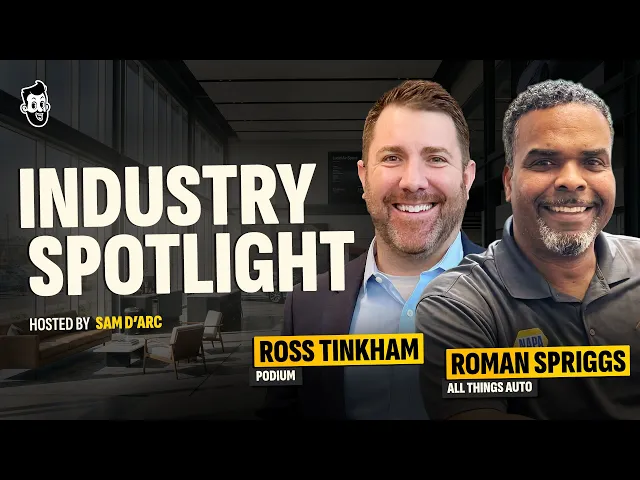
“You're Already Late!” Why AI is No Longer Optional in March 2026 (+ How To Hire Your First Agent)
Summary
Roman Spriggs, General Manager of All Things Automotive, a small, independent used-car dealership, tells host Sam D'Arc how he skipped a planned human hire and instead brought on a Podium AI agent he named Alex after his own son. Alex now fields customer inquiries and books service and sales appointments around the clock, including overnight, and Roman credits it with reinvigorating his sales floor and helping the store post two record sales months in January and February 2026.
Ross Tinkham, VP of Automotive at Podium, joins to explain why independent dealers tend to lag franchise stores by a year or more in AI adoption, and why he thinks that gap is closing fast. For dealers of any size, the conversation is a practical case study in what it actually takes to onboard an AI employee: treating it like a real hire, giving it feedback, and letting it learn a store's own culture and voice rather than expecting it to work on day one.
Key takeaways
Roman hired Alex instead of a fourth salesperson, and the dealership posted two record sales months in January and February 2026.
Ross Tinkham says successful AI rollouts take a 30- to 60-day investment of training and feedback before the agent reflects a dealership's own culture and voice.
Ross estimates independent dealers are roughly a year to a year and a half behind franchise stores in adopting AI, largely due to budget and reputational hesitancy.
About the Host & Guests

Host
Sam D'Arc
COO, Zeigler Auto Group
Sam D'Arc is chief operating officer of Zeigler Auto Group, a multi-state dealer group in the Midwest, and hosts Industry Spotlight on the Car Dealership Guy podcast network, along with Zeigler's Driving Vision podcast. He has more than 30 years in automotive, including nearly two decades with a global direct-insurance provider delivering F&I and insurance solutions to large dealer groups.

Guest
Ross Tinkham
VP & General Manager, Automotive, Podium
Ross Tinkham is Vice President and General Manager of Automotive at Podium, where he leads the company's work with franchise dealers, dealer groups, and OEM programs. At Podium he has held roles spanning automotive sales, OEM and channel partnerships, and go-to-market partnerships. He speaks regularly on AI adoption in dealerships, including at the 2026 NADA Show.

Guest
Roman Spriggs
General Manager, All Things Automotive
Roman Spriggs is general manager of All Things Automotive in McConnellsburg, Pennsylvania, a used-car dealership that also operates a service and repair shop, tire store, quick lube and NAPA parts store. He has spoken on Car Dealership Guy about adopting AI agents in dealership operations.
Timestamped Chapter Markers
00:00 – Introduction
00:33 – Meet Roman Spriggs and Ross Tinkham
03:52 – Your sales team isn't the problem... this is
06:03 – I replaced a salesperson with AI... here's what happened
09:23 – The first night Alex booked an appointment
13:17 – This AI turned a dead sales floor into chaos
17:14 – If you don't have AI yet... you're already losing
20:36 – You won't be able to tell AI from humans soon
21:41 – Most AI companies will burn you
22:14 – What to look for in an AI partner
23:18 – Buyers can now shop 100 dealers instantly
24:24 – Customers now expect replies at 2 a.m.
26:02 – CRM tasks are killing your dealership
27:08 – Why the first 30 to 60 days of training matter
How did Roman Spriggs get started in the car business?
Sam D'Arc: Hey, everybody, welcome back to another episode of the Car Dealership Guy Industry Spotlight. I'm your host, Sam D'Arc, and coming up today: a 35-car-a-month salesperson, Roman Spriggs, turned sales manager, then turned general manager, shares his strategy in small-town America to deliver vehicles coast to coast, all utilizing an AI agent he named after his own son, Alex. Learn three tips for buying, installing, and training AI in March 2026, and two things to absolutely avoid when considering who to trust with the tech solution.
Sam: [Sponsored by Podium] Joining the show today: Roman Spriggs, GM of All Things Automotive, and Ross Tinkham, Vice President of Automotive at Podium. Thanks to Podium for supporting today's content. Let's get into it.
Sam: So Roman, you're an independent used-car dealer in a rural area. How'd you get into the car business? How'd you get into being a used-car GM at a dealership that's part of a larger dealer group? What's the Roman Spriggs story?
Roman Spriggs: I was introduced by a sales manager who liked my charisma years and years ago, and I got into the business at our Subaru Hyundai store back in Cumberland, Maryland, as a salesperson.
Sam: Thirty to forty, upper forties cars a month. Sold a lot of cars. How long ago is this, Roman?
Roman: Back in 2006, 2007. Sold cars for a few years, and then came the general sales manager talk, and I led a successful sales floor.
What made Roman move from sales into management?
Sam: You sold a ton of cars as a salesperson. What made you say, “Hey, I want to take this leadership role, I want to become a sales manager”?
Roman: I wouldn't want to put everybody in one group, but most high-performing salespeople, or salespeople period, look over at the desk and think, “I want to do that.” A lot of high-performing salespeople think, “I can connect with a customer, I can answer the phone calls, I can respond to the emails.” Right up until the number you said, thirty, forty cars a month. I did it.
Sam: And it lights a certain character type up. I think you might be that. So what was it about leadership that got you to say, “I want to take that call, I want to answer that call, I want to go down that road”?
Roman: I like the people I work for. I like Mark Thomas, obviously, and Chris Carpenter, who's now a partial owner. We sat down and talked, and I thought, if I could touch all of the customers, in our narrow-minded way of thinking back then. Because the way it shakes out is that never happens, since once you're a sales manager you get all these other things.
Roman: You're chasing used cars, and chasing, and I wanted to help them. I thought we could move the needle, which we did. And it's funny you said what you said, because my sales manager before that told me, “Hey listen, you're doing really well. Do me one favor: whenever they come asking you to be a manager, please just stay a salesperson.”
Sam: It was going to come. And why not? Because, by the way, I can tell from your personality you do really well connecting with the customer, you do really well telling your story, and you probably thrived and loved selling cars, I'd imagine.
Roman: Teaching, training, diving into the hearts of the employees, I still do it today. But let me answer your question honestly: ego.
Sam: Okay, let's just call a spade a spade. Ego, right? That's really honest. So I've got a question for you: you had that success, thirty, forty cars a month. Most people in automotive don't get up to that unit count. Didn't it just drive you nuts when you had a sales team and they weren't picking up the phone, they weren't engaging with the customer, they weren't responding to those leads? How'd you deal with that in the early days as you were building that sales floor?
Why do sales teams struggle to engage customers today?
Roman: It was tough, because you know what you know, and one of the challenges was trying to convey something that might have been natural to me to someone else: “Hey, listen, listen, listen.” And then, on any sales floor, trying to get them to understand that we're on the same team here. I'm not browbeating you, I just, you're missing some things that could really be helpful to you.
Sam: Yeah, the younger generation, they don't want to hear, “I used to score forty points a game,” you know.
Roman: But the biggest challenge is conveying and getting them to understand how important it is, and trying to get them to pick up the phone, answer questions, and ask the right questions. It's all part of the bigger picture.
Sam: Why do you think you, as a salesperson all those years ago in the early days, were so good at sales on the phone, responding, engaging? Why is it such a challenge today, in March of 2026, to get salespeople, BDC reps, to do the exact same thing? Why isn't it easier to train on that and get that engagement?
Sam: In my role at Ziegler Auto Group, I see the challenge of getting this younger generation to really engage in a way that connects with the customer. And add to that, borderline, sometimes unreasonable expectations by customers. They want a phone call picked up at 2:00 a.m., or a service appointment responded to at 6:00 at night.
Sam: So enter general manager, used-car facility, part of a three-store group, very well regarded in your area. You want to win, sell a ton of cars, you've got salespeople. You went to AI and technology rather than forcing people to do something that's just hard to get them to do.
Why did Roman choose an AI agent over hiring another salesperson?
Sam: There was that decision moment where you're like, “Am I willing to spend the money, the time, the effort to engage in this AI versus forcing people to do something?” Why did you decide to go the AI route?
Roman: Small store, you've got to make every dollar count.
Sam: What made you confident enough to invest in AI?
Roman: I was on the fringe of hiring another salesperson. Our principal likes to add salespeople, and I pitched it to Mark. I got an idea from a couple of other guys in the org who I regard highly: instead of hiring a physical person, I could hire this agent.
Roman: I don't want to throw the numbers out there, but for X amount of dollars, for this agent, I looked at it as an employee that I can tell exactly what to do. It's going to do it. It's not going to talk back. I don't have to write it up. I don't have to spend time correcting it.
Sam: But you do have to train it. You've got to get it bought off in your culture and the way you do business. You named this agent something that was meaningful to you. What did you name it?
Roman: My son's name. Alex.
Sam: Alex, very cool.
Roman: Gender-neutral, and just fitting.
Sam: So enter Ross Tinkham, Podium. Ross, when you got the call from Roman and he's like, “Look, small dealer, independent used, I want my guys to deliver an incredible customer experience to every single customer walking in here, I'm going to hire an AI agent, I'm going to name him after my son,” what went through your mind, Ross?
Ross Tinkham: I think it's an absolute perfect fit for Podium and for AI. We pay a lot of attention to what happens in the franchise world, and we know the appetite for AI, it's talked about a lot. It doesn't get talked about as much in independent, and generally my observation is independent dealers are maybe a year, year and a half behind the adoption curve.
Sam: Why is that?
Ross: Just appetite, spend, dollars, budget.
Sam: Why?
Ross: That's a good question, I don't know. And that's a general statement; I'm sure there are folks who innovate and are ahead of the curve. But AI is a new technology, and I think when you're running a smaller store, it's all on you and your own reputation.
Ross: I think there's a lot of hesitancy, if we hire this AI agent and it messes up with a customer, that reflects poorly on me as a business owner. I'm not saying a franchise dealer doesn't operate that way, but it's a little bit more intimate with a lot of the independent dealers we work with. The other side of the coin is they're running so thin, in most cases there's no service drive, it's all about moving units, everyone's wearing multiple hats.
Ross: You're just not staffed to the degree you are with humans like a franchise, where AI can become a great fit even for somebody in a more rural area.
Sam: Ross and Roman, I often talk on the show and say, “In this world of AI today, a new role of a general manager, no matter the size of the store, is to grow, develop, and invest in these AI agents so that they become part of your culture.” Roman, when you plugged this new AI agent in and started having this experience, what were some of the early challenges you faced or learnings you had to get around to make it successful in your store?
What happened the first night Alex went live?
Roman: The first challenge was, they plugged it in on, let's say, a Wednesday night. I came in Thursday morning trying to figure out how he made this appointment overnight, and the customer showed, and I'm thinking, that was my biggest challenge. Literally the first customer, I came in in the morning, I'm looking at Podium, and I'm thinking, “When...” and then I had to start thinking through the process, because initially I'm like, “Okay, they told me all these things.”
Roman: Which, I'll say this, in most cases people over-promise and under-deliver. They under-promised, really, and I'm no spokesman for them, but...
Sam: In what way did they under-promise, as you say, with this tool?
Roman: Austin had about an hour with me on a demo, and I think he even went over because I was so inquisitive. The way he explained it, very professionally, I have gotten more than he demoed, I can tell you that. And that's no knock on Austin, because he did a great job, as well as the rest of the team. They shorted themselves, and I know Ross is sitting there tickled pink, I'm sure, but it's just the facts. I didn't expect to get what we got.
Sam: Roman wasn't expecting what he got, it over-delivered. Yet I think in the independent world and smaller-dealer world, a lot of dealers wedge against new-car dealers by saying, “We're not like those big-city guys, you're going to get a different experience here.” Ross, Podium or related AI companies, you have a responsibility to defend that small-town feel. You've got a responsibility to defend the perception that you connect with the consumer better than the big guys do. How do you do that at Podium with AI technology? How do you deliver above and beyond?
Ross: I think the most important thing we can do to support that, and to over-deliver, is the ability to customize AI to be whatever it is you need it to be. That goes much further than how you schedule a test drive or follow process steps, it's tone, it's voice, it's what language you'd like it to use to interact with your customers. I think we make that pretty easy, and do it in a way I haven't seen anyone else in the market do.
Ross: If we go back to what you're doing, you're hiring an employee. That's the framework you have to operate from. If you do that with a human, you can build it into whatever you want it to be, and it should really be the same with AI.
Sam: So Roman, how many salespeople do you have right now, excluding Alex?
Roman: I have three, and a sales manager.
Sam: So when you went to your salespeople and your sales manager and said, “I'm going to plug in this AI agent, I'm going to name him after my son, we're going to train him and he's going to help us set appointments,” what was some of the skepticism you got initially, before Alex started actually setting the appointments?
Roman: I didn't get much, Sam. I didn't get much. I'm a pretty strong personality, and they trust me.
Roman: And I have to say, again, Austin from Podium called me at the right time, because I was going through a DMS change, going from a Cadillac to a Cobalt, the CRM, and the way the leads came in. That's why I said to Ross, I wouldn't even want to know where we'd be without Podium right now. No skepticism at all, they were excited.
Roman: And that's where I wanted to lead into a little bit: this thing has reinvigorated the sales floor.
How has Alex changed the energy on the sales floor?
Sam: What's an example? We've all been on sales floors where you walk in: “Hey, follow up, did you do your task?” And the salespeople are just demotivated.
Roman: This thing all of a sudden has the floor buzzing, people asking questions, selling cars, because salespeople really do want to work. We think in the dealership, replace them, pep them, get them out of here. No, we have to find a way to motivate them, and what it did was it helped me motivate that sales floor. We had two record months, January and February. We usually start the first quarter behind the mark.
Roman: And again, I said to Ross, in a blanket statement, I'd hate to see where we were at, but I love where we're at, and I know why. It's the smaller things it's done. It's reinvigorated things, and it's made selling cars fun again. Where before you'd get on these salespeople, “I can't get a hold of a customer and they won't respond,” this thing has made them come in to work, and the first thing they check in the morning is Podium.
Sam: For other dealers your size, walk us through what Podium actually does for the dealership day to day. What does it look like once it's in place? How do you engage and interact with it? How do you train Alex?
Roman: It makes it easy, and they keep adding things. Like I noticed the other day, one little pain point we had to figure out, it would say the car was available. So now it asks the question before it responds to the customer: is this car available? And I get it at night, I answered one last night. Initially they come in, they check, what's Podium look like day to day. They check their dashboard, see what's going on. They check reviews, it gives reviews, and you want to check and see if your customer is giving a review, and it does that.
Roman: It checks their funnels. I make sure they check their new leads first, we assign those leads, then they have to place them in a funnel, follow up, do all the things. But more importantly, it keeps a running tab in real time of what's going on with your customer. The AI agent itself lets you know what's going on. It makes notes, because God knows salespeople love making notes, right? Alex loves making notes, to let you know exactly what's going on.
Roman: There's transcription, and during the course of the day you can't miss it, because it beeps my phone: “Hey, Alex needs your assistance.” If the AI needs assistance with anything, a customer question, negotiating, things like that, it knows its bounds. As far as training it, if you don't like a response, you just give it a thumbs down, tell it what you want it to say, and I bet the next one or two responses, it says it. It's really been plug and play.
Sam: And that's a fair point, Roman, because if you implement something like this, you onboard it as an employee, you don't train it, you don't spend the time working with it, giving it thumbs up, thumbs down, answering questions as it converts over to you, it's not going to develop into part of the culture. You've got to make that investment, Roman, which you've done.
Roman: Yeah. I don't want to tear the industry up, but that's the negative in the industry, right? We try to plug and play people, give them their business cards, give them their passwords, and say go sell, with no commitment or investment. And I know, this was my first decision as a general manager, so guess what? It's going to work. I'm going to invest.
How far behind are dealers who haven't adopted AI yet?
Sam: Yeah, it's going to work. So Roman, walk us through your thought process: thinking about the next couple of years, two years down the road, what does dealership life at your dealership, independent, smaller town, look like in two years with versus without AI? How far behind will dealers be that don't have this in two years?
Roman: If you don't have it now, you're behind.
Sam: Why?
Roman: You just don't, that's where it's at. Right now within the AI industry, because I pay attention, it just keeps evolving. If you're not there now, you're especially behind the mark for this selling season. Two years from now, I don't even want to know.
Sam: Ross, it's interesting, from Podium's perspective, automotive, we're not early adopters. We want something proven before we plug it in. And in Roman's case, he had enough confidence to make this bet, of course he took a little bit of a risk, but he named it after his son, and it's had success. What advice do you give to most dealers that are kind of on the fence? How do we implement AI? When do we implement it? And once we've implemented, how do we engage with it to ensure it succeeds?
Ross: I think we run into most frequently what I'd call two types of buyers: those who are on the fence and haven't tried it, or those who've tried it and it's gone very poorly. That's generally what you run into. And for the most part, the folks we talk to who've tried it are not happy with what else they're using.
Ross: I think the level of comfort in the industry with AI is at a level where, if you're working with the right provider, you onboard it well, and you integrate it into your processes, you're in a pretty good spot to have success. Early on, two years ago, probably a lot of hallucinations, a lot of challenges, but I think the industry has largely worked through that. So for the most part, you can feel pretty confident that if you do it the right way, and that's more than just the software, it's getting buy-in from your team, adjusting people's comp plans if you run a BDC, there's a lot to think about there.
Ross: But if you do it the right way, you're in a pretty good spot. We try to make it very easy to understand what AI is delivering to you, what is it scheduling, what appointments. We're now doing a lot, we started on the sales side, now we're on the service side too, trying to break those two pieces apart, help the dealer understand the value AI is driving. If we're not doing that, you're not going to know. So you've got to be doing that. And I think it's really just the ongoing training, as things change for you and your team, of continuing to fine-tune AI and bring it along with you as things change for the dealership.
When will AI voice be indistinguishable from humans?
Sam: So thinking about what Podium's tool Alex, in this case, again named after Roman's son, has given him and their dealership in terms of scheduling, customer communication, customer interaction, engagement, what's next for the independent auto, or even the franchise dealer, in AI? Where are things headed over the next six months, the next year, Ross? What can we look forward to next?
Ross: Listen, just coming out of NADA, I'm part of Livo, so months ago feels like a year ago, everyone just wants to talk about voice. That's been mentioned on your show quite a bit, Sam.
Ross: It's getting there, you can still tell it's not a person. I've not listened to any voice solution where it's as good as a human. But—
Sam: When will it be there, do you think, in your opinion? And what's the benchmark for success in voice AI?
Ross: There will be a point in time in which you will not be able to distinguish AI voice from human voice.
Sam: When does that happen?
Ross: I don't know, six months is probably too soon. A year, a couple of years, eighteen months, not far on the horizon, but not quite there.
Sam: Yeah, not quite there.
Ross: But the question, though, Sam, is does that matter as much? If you're calling to make a service appointment and nobody ever picks up the phone, and you leave a voicemail and can't get in touch with anybody, would you prefer that versus an AI agent picking up the phone and helping you with what you need help with? Do people care as much, as long as their problem is solved or their need is taken care of?
Ross: And that's where I think we're at, it can do the job. It might not sound just like a human, but it can get the job done in a far better way than a lot of the existing processes most dealers have in place.
Sam: So I know Podium has a newer voice AI tool, right? I think you launched it at NADA. Roman, do you use that yet? Have you implemented voice AI into your operation as part of Podium?
Roman: No.
What should dealers look for in an AI voice partner?
Sam: What's the bench, when would you, Ross, go to Roman and say, “Hey, it's there,” or would you say, “Hey, wait a little bit,” or would you experiment with it? What should my strategy be at a smaller store, where every dollar spent is so valuable today?
Ross: Yeah, I mean, it is really important. The company you're dealing with is really important. I'm sure you get a lot of calls from people trying to sell you AI, as every dealer does, I hear about it every day. It's noisy. Here's what I think you need to be cautious of: if you're going to enter in with a voice product, connect with a company that has a track record of really taking your feedback and being able to make the product better based on that.
Ross: Because I think for a lot of companies, that's where voice is, it's not perfect, but it's getting there. We look for partners, it's cliché to say that, but we look for partners because we want feedback from our customers. Everything isn't always perfect, but we want the feedback, and we use that to level up the product every single day of the week.
Ross: So truly, I think looking for a partner is really important when it comes to new technology, especially when we're talking about an AI agent that talks to your customers for you. I think the experience of the business you're working with matters. If they've got five customers but an awesome demo, run, run away. Run away yesterday, save yourself the trouble there.
Sam: Yeah. All right, so voice AI is emerging, and that's probably going to be the buzzword for 2026, as dealers become more comfortable with it and figure out how to engage with it. What's beyond that? What's just beyond that, Ross, for a dealer like Roman?
How will AI change the way customers shop for cars?
Ross: So there's two ways to answer that question: one is from a dealer's perspective, the other is from a consumer perspective. What's starting to get talked about more is that we, as consumers, will use AI to do things like go source a car, that will let me shop a hundred dealerships simultaneously. So most dealers are probably going to see lead volume go up, but there's going to be a whole lot more to sift through.
Ross: So I think part of it is what's coming next in the technology from a dealer's standpoint, but also how your customers are going to leverage AI to a greater degree to buy from you in the next six to twelve months, and that's probably more important to think about.
Sam: Yeah. It's interesting, as we get toward the end of our time together, I love Roman's story. Sold cars, sold a ton of cars, was very successful, wanted to share that success with others, and realized, in this competitive environment, something we believe at my auto group a lot, AI is creating a level of expectation by consumers that very quickly is going to be absolutely impossible for people to deliver on.
Sam: Not only tough, because we don't like to answer the phone, period, but impossible to deliver on. Phone calls at 2:00 a.m., text messages at 5:00 a.m., a service update, Roman, at 5:00 p.m. when everybody's checking out of service all at once. And AI, well-trained, can deliver that. And I love that you named the AI agent after your son, what does that mean to you, that you've set an example in automotive that really continues the legacy you began selling cars with? I think that's pretty cool, Roman.
Roman: Yeah, it's cool to go around a dealership and know there's no negative, if you're in the auto industry, like yourself, Sam, there's always the chatter in the huddles about what's not working. They never talk about what's working. But when I walk through there, “Man, check this out, Roman, look what Alex said here,” it's just like another employee. It's cool. And like I said, it's making automotive fun again. Automotive became not fun for a hot minute, and I'm sure you can find some showrooms that still aren't fun.
Roman: That's the biggest thing, it's exciting again, and that's in large part due to this product.
What's Roman's advice for dealers still on the fence?
Sam: All right, Roman, so as we close out, what advice would you give to the dealer that's sitting squarely on the fence right now? They're like, “Hey, I know AI was the buzzword at NADA, I hear a lot about it all over the internet, but I'm not totally convinced that at the end of the day, this smaller store, I can't just deliver a great experience for every customer.” What's the advice?
Roman: If you haven't done it, you're late.
Roman: Any advice is: look into it. Check your lead responses in your CRM. See if you're tired of the CRM and tasks and all of that. Do you want to work harder or smarter? Do you want your customers to hire you, or silently fire you? Or do you still want to keep chirping down your salespeople's backs and your sales managers' backs about tasks and follow-ups? Do you really have time to do that? My answer, as a former sales manager to a general manager: no. Pay somebody to do it. We do it everywhere across the industry.
Roman: We pay the dent guy and the paint touch-up guy, why aren't we paying for the guy who takes care of what we like to do, and at the effectiveness that they do it? That's pretty insane to me.
Sam: Now Ross, as we wrap up, it does occur to me, based on what Roman is saying, success in 2026 in automotive, big or small dealer, you can't just plug an AI tool in and have the lights come on and it's automatically working. You do have to develop it, understand it, train it to adapt to your culture.
Why do the first 30 to 60 days of training matter most?
Sam: Timing is an important element of implementing AI in 2026. I learned that at NADA, just walking around and seeing it, there are dealers that are so far ahead, and there are others that are behind. Any thoughts as it relates to timing and training as an expectation into 2026, Ross, as we wrap up?
Ross: Yeah, I mean, any worthy investment is going to take some time on your part, especially when we're talking about replacing or augmenting your staff with an AI employee. So generally what I'd say is: if you're a single-point dealership and we're just getting off the ground with you, you really have to invest in those first 30 to 60 days. If you're a larger group, you extend that timeline a bit. But it's going to take your first 60 days to put in the work.
Ross: But again, look for something that makes it easy for you to do that. You don't want to have to put together an email and send it to a support address to get changes made to your AI agent. You shouldn't need a DMS for that matter, who does that?
Sam: Ross, I can list them.
Ross: Yeah, but you want to put yourself in a position where you have full control over the outcome.
Sam: Wait, isn't it ironic, Ross, that with AI, it's having better people that is the difference-maker, versus just more AI? I don't want to send a support case to an email address, I want someone I can talk to and get it taken care of.
Ross: Yeah, or you should be able to talk to the agent yourself and tell her what to do. I think that's what we try to deliver on.
Sam: Well, Ross Tinkham, Roman Spriggs, thank you so much, both, for coming on to share your perspectives on all things AI in small-town America used automotive. And Roman, thanks for being forward-thinking in naming your AI and sharing your experiences, not only for yourself but for your team. And thanks for sharing your best practices here on Car Dealership Guy Industry Spotlight. Thanks for being on the show.
Roman: Oh, man, thank you. Thanks for having me.
" width="1420.5180000066757px"><path d="M 0 0 L 1420 0 L 1420 296 L 0 296 Z" fill="transparent" height="296px" id="nEUrsAEtA" transform="translate(0.518 9.913)" width="1420px"/><path d="M 1101.408 94.796 L 1162.108 94.796 C 1162.708 101.291 1163.218 106.75 1164.008 115.715 C 1182.088 95.792 1202.098 86.826 1226.818 90.094 C 1238.317 91.244 1249.326 95.332 1258.788 101.966 C 1268.28 108.62 1275.911 117.591 1280.958 128.027 C 1311.458 88.938 1342.858 79.295 1378.608 97.147 C 1390.369 102.775 1400.329 111.571 1407.368 122.546 C 1414.426 133.558 1418.299 146.309 1418.558 159.387 C 1420.848 206.206 1419.188 253.185 1419.188 301.12 L 1358.558 301.12 L 1358.558 258.365 C 1358.558 233.78 1359.078 209.194 1358.008 184.649 C 1356.858 158.948 1347.168 146.994 1329.408 146.317 C 1310.938 145.6 1296.428 157.673 1293.818 181.661 C 1290.848 210.589 1291.678 239.916 1291.008 269.084 C 1290.768 279.006 1291.008 289.007 1291.008 300.443 L 1229.388 300.443 C 1229.388 268.924 1229.628 237.326 1229.388 205.768 C 1229.388 194.531 1230.378 182.258 1226.338 172.337 C 1222.308 162.415 1213.128 148.867 1205.188 148.11 C 1194.468 147.114 1179.828 154.206 1172.318 162.734 C 1165.438 170.703 1163.818 184.729 1163.418 196.205 C 1162.348 230.592 1163.058 265.019 1163.058 300.722 L 1101.408 300.722 Z M 987.455 300.441 C 986.941 293.906 986.466 287.49 985.754 278.366 C 962.024 309.446 931.768 312.912 900.207 300.281 C 867.578 287.251 855.673 258.323 854.803 225.171 C 853.695 182.256 854.526 139.262 854.526 95.072 L 916.264 95.072 C 916.264 118.582 916.066 141.613 916.264 164.604 C 916.264 182.495 916.66 200.466 917.727 218.277 C 918.756 235.371 926.824 247.565 944.938 249.278 C 963.052 250.991 976.183 242.624 981.364 225.37 C 984.657 213.266 986.319 200.777 986.308 188.233 C 986.98 157.83 986.506 127.387 986.506 95.391 L 1047.608 95.391 L 1047.608 300.361 Z M 803.391 300.881 L 744.065 300.881 L 744.065 95.633 L 803.391 95.633 Z M 803.232 54.906 L 743.907 54.906 L 743.907 0.316 L 803.232 0.316 Z M 629.089 0 L 629.089 110.095 C 572.928 79.932 532.31 84.515 500.234 123.524 C 466.458 164.605 465.904 229.913 499.285 270.955 C 506.713 280.676 516.027 288.798 526.669 294.834 C 537.285 300.856 549.013 304.661 561.142 306.02 C 587.522 309.009 609.195 299.087 628.18 278.805 C 629.129 288.567 629.722 294.744 630.276 300.521 L 690.234 300.521 L 690.234 0 Z M 584.279 249.836 C 556.593 249.836 537.649 228.36 537.847 197.479 C 538.044 166.598 557.108 145.957 585.307 146.395 C 611.845 146.754 631.383 168.351 631.7 197.638 C 632.016 226.925 611.727 249.677 584.279 249.638 Z M 148.037 12.277 C 99.35 4.746 49.161 6.698 0 4.507 L 0 301.362 L 63.597 301.362 L 63.597 209.954 C 88.909 208.799 111.453 209.517 133.443 206.409 C 156.213 203.687 177.278 192.891 192.872 175.955 C 208.466 159.018 217.57 137.044 218.555 113.965 C 221.087 66.029 192.808 19.17 148.037 12.277 Z M 153.02 109.542 C 152.565 119.234 148.447 128.392 141.5 135.166 C 134.584 141.91 125.344 145.745 115.685 145.882 C 99.35 146.639 82.976 145.882 65.1 145.882 L 65.1 69.775 C 84.044 69.775 103.108 67.942 121.657 70.293 C 126.279 70.785 130.757 72.192 134.829 74.433 C 138.911 76.679 142.507 79.712 145.409 83.356 C 148.32 87.01 150.482 91.201 151.773 95.69 C 153.066 100.186 153.463 104.893 152.941 109.542 Z M 338.829 89.813 C 324.732 89.898 310.792 92.777 297.815 98.285 C 284.813 103.805 273.03 111.839 263.142 121.926 C 253.226 132.04 245.393 144.003 240.087 157.135 C 234.77 170.292 232.078 184.362 232.162 198.553 C 232.244 212.743 235.1 226.78 240.571 239.874 C 246.03 252.942 254.003 264.811 264.037 274.807 C 274.043 284.775 285.919 292.668 298.984 298.034 C 312.025 303.388 325.998 306.102 340.095 306.019 C 400.963 305.78 448.225 258.721 448.423 198.155 C 448.542 136.672 400.804 89.454 338.829 89.813 Z M 340.688 247.843 C 315.257 248.281 294.256 226.525 293.583 199.031 C 292.911 171.537 314.545 147.231 340.174 147.231 C 365.13 147.231 385.617 169.625 385.894 197.478 C 386.171 225.33 366.514 247.365 340.609 247.843 Z" fill="rgb(254, 254, 254)" height="307.13419463695845px" id="OhFGo_EHq" transform="translate(0 0)" width="1419.7693369032306px"/><path d="M 540.511 74.99 C 524.515 74.99 512.872 64.967 512.872 48.06 L 512.872 47.25 C 512.872 30.544 524.717 19.71 540.106 19.71 C 553.774 19.71 565.924 27.71 565.924 46.642 L 565.924 50.692 L 527.754 50.692 C 528.159 59.5 532.918 64.562 540.916 64.562 C 547.7 64.562 551.041 61.626 551.952 57.172 L 565.822 57.172 C 564.101 68.612 554.989 74.99 540.511 74.99 Z M 527.957 41.68 L 551.648 41.68 C 551.142 33.683 547.092 29.835 540.106 29.835 C 533.525 29.835 529.071 34.189 527.957 41.681 Z M 475.019 73.876 L 455.681 20.926 L 471.374 20.926 L 484.03 58.79 L 496.584 20.925 L 510.758 20.925 L 491.522 73.875 L 475.019 73.875 Z M 432.399 73.876 L 432.399 20.926 L 446.978 20.926 L 446.978 73.876 Z M 447.254 0 L 432.123 0 L 432.123 13.572 L 447.254 13.572 Z M 413.441 74.887 C 402.304 74.887 396.331 69.217 396.331 58.182 L 396.331 31.352 L 389.548 31.352 L 389.548 20.924 L 396.331 20.924 L 396.331 9.484 L 410.91 9.484 L 410.91 20.924 L 422.047 20.924 L 422.047 31.352 L 410.91 31.352 L 410.91 56.866 C 410.91 61.118 413.036 63.143 416.782 63.143 C 419.01 63.143 420.63 62.839 422.351 62.13 L 422.351 73.47 C 420.326 74.178 417.39 74.887 413.441 74.887 Z M 356.42 63.853 C 364.621 63.853 369.379 57.779 369.379 47.756 L 369.379 47.046 C 369.379 36.923 364.621 30.848 356.42 30.848 C 348.321 30.848 343.461 36.72 343.461 46.844 L 343.461 47.654 C 343.461 57.779 348.118 63.854 356.42 63.854 Z M 356.319 74.99 C 340.525 74.99 328.477 64.46 328.477 47.958 L 328.477 47.148 C 328.477 30.544 340.525 19.711 356.42 19.711 C 372.316 19.711 384.262 30.341 384.262 46.844 L 384.262 47.654 C 384.262 64.36 372.214 74.99 356.319 74.99 Z M 238.283 73.877 L 238.283 20.926 L 252.963 20.926 L 252.963 29.026 C 255.596 24.064 261.265 19.711 269.162 19.711 C 276.148 19.711 281.413 22.647 283.944 28.924 C 288.196 22.546 295.081 19.711 301.763 19.711 C 311.584 19.711 319.177 25.887 319.177 39.96 L 319.177 73.877 L 304.598 73.877 L 304.598 41.58 C 304.598 34.796 301.561 31.759 296.296 31.759 C 290.626 31.759 286.07 35.404 286.07 42.592 L 286.07 73.877 L 271.491 73.877 L 271.491 41.58 C 271.491 34.796 268.352 31.759 263.189 31.759 C 257.519 31.759 252.963 35.404 252.963 42.592 L 252.963 73.877 Z M 200.599 63.853 C 208.799 63.853 213.558 57.779 213.558 47.756 L 213.558 47.046 C 213.558 36.923 208.799 30.848 200.599 30.848 C 192.499 30.848 187.639 36.72 187.639 46.844 L 187.639 47.654 C 187.639 57.779 192.297 63.854 200.599 63.854 Z M 200.497 74.99 C 184.703 74.99 172.655 64.46 172.655 47.958 L 172.655 47.148 C 172.655 30.544 184.703 19.711 200.599 19.711 C 216.494 19.711 228.441 30.341 228.441 46.844 L 228.441 47.654 C 228.441 64.36 216.393 74.99 200.497 74.99 Z M 157.068 74.887 C 145.931 74.887 139.958 69.217 139.958 58.182 L 139.958 31.352 L 133.174 31.352 L 133.174 20.924 L 139.958 20.924 L 139.958 9.484 L 154.537 9.484 L 154.537 20.924 L 165.674 20.924 L 165.674 31.352 L 154.537 31.352 L 154.537 56.866 C 154.537 61.118 156.663 63.143 160.409 63.143 C 162.636 63.143 164.256 62.839 165.977 62.13 L 165.977 73.47 C 163.953 74.178 161.016 74.887 157.068 74.887 Z M 93.355 74.99 C 83.028 74.99 75.334 68.915 75.334 55.045 L 75.334 20.925 L 89.913 20.925 L 89.913 53.02 C 89.913 60.208 92.849 63.65 99.126 63.65 C 105.302 63.65 110.162 59.804 110.162 52.008 L 110.162 20.926 L 124.741 20.926 L 124.741 73.876 L 110.162 73.876 L 110.162 65.574 C 107.428 70.94 102.062 74.99 93.355 74.99 Z M 0 73.876 L 23.792 1.486 L 45.155 1.486 L 68.644 73.876 L 51.534 73.876 L 46.572 57.778 L 20.35 57.778 L 15.39 73.876 Z M 33.512 14.85 L 23.894 46.134 L 43.029 46.134 Z" fill="rgb(255, 255, 255)" height="74.99000044250488px" id="QMlTFlhjs" transform="translate(853.5 6)" width="565.9240092773438px"/></g></svg>)